
If you are relocating to the Valley of the Sun, the suburb you pick today is not the suburb it will be in five years. The Phoenix metro is one of the fastest-expanding regions in the country, and the growth is not evenly spread. It is concentrated in two corridors of newer, more affordable towns where homebuilders still have room to work. Knowing which towns are growing fastest tells a relocating buyer where new inventory, new schools, and new price pressure are heading.
This list ranks eight Phoenix-area suburbs by their most recent year-over-year population growth, using Arizona Office of Economic Opportunity July 2025 estimates and World Population Review data. Each entry pairs the growth figure with an approximate 2026 median home price so you can see what the growth costs. Prices are approximations drawn from the sources at the end. Verify against current Redfin or Zillow data before you make an offer.
How we ranked these 8 fastest-growing Phoenix suburbs
The ranking is by approximate year-over-year population growth from the July 1, 2025 Arizona population estimates, the freshest official count available. We then layered on the five-year trend where it tells a sharper story (Buckeye is the standout), the growth corridor each town sits in, and an approximate 2026 median sale price. Note that a few of these towns sit in Pinal County rather than Maricopa County, but all of them function as Phoenix-metro commuter and exurb markets.
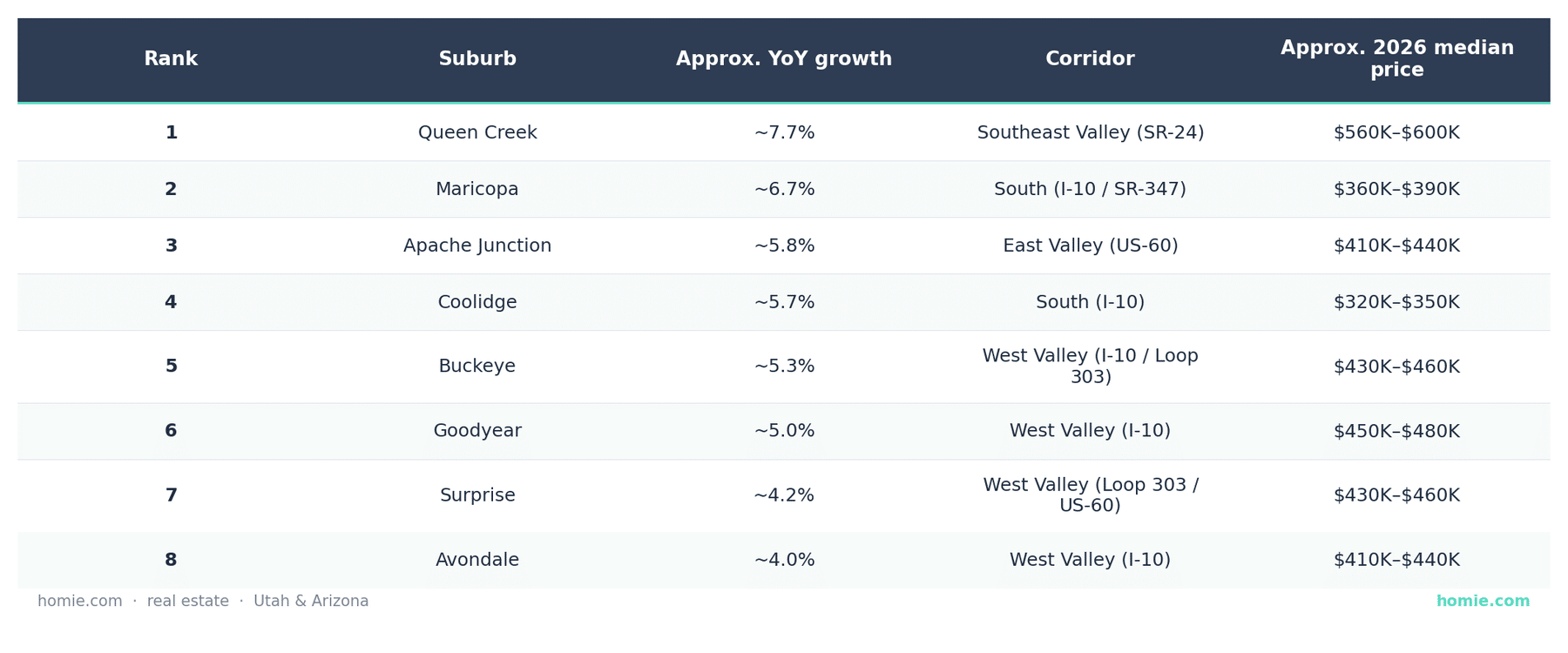
*Growth figures are approximate and vary by source and measurement window. Prices are illustrative and move month to month.*
1. Queen Creek: the Southeast Valley growth leader
Queen Creek grew roughly 7.7% in a single year and recently passed the 89,000 mark, which puts it among the fastest-growing towns in the entire country and the fastest in the metro. The new SR-24 freeway is opening land to the east and south, and master-planned communities keep absorbing buyers priced out of Gilbert and Chandler. Expect an approximate median in the high-$500,000s, newer construction, larger lots, and a longer commute to central Phoenix. It suits families who want new homes and space and do not need a short downtown commute.
2. Maricopa: the affordability anchor of the south corridor
The city of Maricopa, in Pinal County south of the metro along SR-347, grew nearly 6.7% year over year. Its draw is price: an approximate median in the high-$300,000s buys newer construction that costs far more closer in. The tradeoff is the commute, since SR-347 is the main artery north toward the I-10 and the Chandler job centers, and it backs up. Maricopa fits commuters and first-time buyers who will trade drive time for a new home they can afford.
3. Apache Junction: the East Valley value edge
Apache Junction sits at the far east edge of the metro under the Superstition Mountains and grew close to 5.8%. It has long been one of the more affordable East Valley entry points, with an approximate median in the low-$400,000s and a mix of older stock, manufactured-home communities, and newer builds. It suits buyers who want East Valley access and mountain scenery without East Valley prices, and retirees drawn to the area’s established 55-plus communities.
4. Coolidge: the Pinal County frontier
Coolidge, further down I-10 in Pinal County, grew about 5.7% and carries the lowest approximate median on this list, in the low-$300,000s. It is a smaller town riding the same Pinal County expansion that is reshaping Maricopa and Casa Grande, with new logistics and manufacturing investment in the corridor. It fits investors and budget-focused buyers comfortable being early in a town that is still building out its services.
5. Buckeye: the five-year growth story
Buckeye’s year-over-year number, around 5.3%, undersells it. Over five years its population jumped roughly 50%, from under 70,000 to past 100,000, one of the steepest climbs of any U.S. city. It anchors the West Valley growth push along I-10 and Loop 303, with master-planned communities and an approximate median in the mid-$400,000s. It suits families who want new construction and are betting on the west side’s long-term build-out, with the caveat that the central-Phoenix commute is real.
6. Goodyear: the maturing West Valley hub
Goodyear grew about 5.0% and is further along its curve than Buckeye, with more retail, employment, and amenities already in place. The approximate median sits in the mid-to-high $400,000s. With distribution centers, an expanding healthcare presence, and spring-training infrastructure, Goodyear suits buyers who want West Valley growth but prefer a town that already has its services built rather than one still under construction.
7. Surprise: established growth on the northwest edge
Surprise grew roughly 4.2% and offers a wide range, from active-adult communities like Sun City Grand to family subdivisions, with an approximate median in the mid-$400,000s. Its position along Loop 303 and US-60 has made it a steady northwest-valley destination. It fits both retirees and families who want established neighborhoods and do not mind the longer reach to the east-side job corridors.
8. Avondale: the close-in West Valley option
Avondale rounds out the list at about 4.0% growth, and its appeal is proximity. It sits closest to central Phoenix of the West Valley towns here, which trims the commute that weighs on Buckeye and Goodyear buyers. With an approximate median in the low-to-mid $400,000s, it suits buyers who want West Valley pricing with a shorter drive to downtown and Sky Harbor.
West Valley vs. Southeast Valley: which corridor fits you?
The metro’s growth splits along two corridors, and they are not interchangeable. The West Valley, along I-10 and Loop 303, runs through Buckeye, Goodyear, Surprise, and Avondale, and it is the bigger raw-land play with the longest commutes to the East Valley tech corridor. The Southeast Valley and the south corridor, along SR-24, the SR-347, and I-10 toward Queen Creek, Maricopa, and Coolidge, sit closer to the Chandler and Gilbert job base but still ask for a real drive.
Residents on r/Phoenix and r/azrealestate consistently flag the same two themes for relocating buyers: the I-10 commute from the West Valley is the single most common regret, and summer utility bills in new far-flung subdivisions surprise people who underestimated cooling a larger home. Treat the community sentiment as lived experience, not data, and check a real commute at the hour you would actually drive it before you commit to a corridor.
Frequently Asked Questions
What is the fastest-growing suburb of Phoenix?
By the most recent year-over-year population estimates, Queen Creek is the fastest-growing community in the Phoenix metro, growing roughly 7.7% in a single year. Over a five-year window, Buckeye shows the steepest climb, with its population rising about 50%. Both figures are approximate and depend on the measurement window and source.
Are the Phoenix exurbs cheaper than Phoenix itself?
Generally the far-out growth towns like Maricopa and Coolidge carry lower median prices than close-in Phoenix and the established East Valley suburbs, which is a large part of why they are growing. The savings come with a commute and, in the newest subdivisions, higher cooling costs and HOA dues. Run the full cost of ownership, not just the sticker price.
Which fast-growing Phoenix suburb has the shortest commute?
There is no single answer, because it depends on where you work. For East Valley and Chandler job centers, the Southeast Valley towns are closer. For central Phoenix and the airport, the close-in West Valley options like Avondale cut the most drive time. Test your actual commute before choosing.
Do these fast-growing suburbs have enough schools and services?
It varies. Established towns like Goodyear and Surprise have built out much of their retail, healthcare, and school capacity, while the newest subdivisions in Buckeye, Queen Creek, and the Pinal County towns are still catching up, with new schools and services arriving on a lag behind the rooftops. Check the specific community’s current school assignments and drive times to services.
That’s the lay of the land on where the Valley is actually growing. If you’re relocating to Arizona and want a brokerage that will run the real commute-and-cost math with you before you fall for a model home, homie.com/buy is a good place to start. We’re a licensed real estate brokerage. The growth and price figures here are approximations, so confirm the current numbers on Redfin or Zillow before you write an offer.
— The Homie Team
- Arizona Office of Economic Opportunity, July 2025 population estimates
- World Population Review, fastest-growing cities in Arizona
- Arizona Capitol Times, Valley cities outgrowing Phoenix
- Redfin Arizona Housing Market
- Community research: r/Phoenix and r/azrealestate relocation threads