
Most Utah buyers spend 60 to 80 percent of their search time scrolling photos and video before they ever set foot in a home, and 2026 has added a new wrinkle: AI-generated staging is now common enough that some listings show furniture that does not exist. This guide walks through how to read Utah listing photography critically, what red flags to look for, when 3D tours and floor plans are worth the time, and what to ask the listing agent before scheduling a tour. The goal is not to make you distrust every listing. It is to make the difference between a great-photo, mediocre-house surprise and a great-photo, great-house tour. Both still exist on the Wasatch Front MLS.
Professional vs. amateur listing photography in Utah
Utah listing photos fall along a quality spectrum. Recognizing where a listing sits helps calibrate what the photos are actually telling you. Professional listing photos in Utah typically show:
- Even, balanced lighting that does not blow out windows or shadow corners
- Straight vertical and horizontal lines (the walls are not tilted)
- Wide but not distorted perspective, with consistent room geometry
- Color-corrected wood tones and paint colors that match real-world appearance
- 20 to 40 images for a single-family home, covering every room and exterior elevation
- Twilight exterior shots for higher-priced listings ($800K+)
Amateur or smartphone photos tend to show:
- Bright window blow-outs (the window is solid white)
- Tilted verticals and skewed corners
- Tight, single-corner shots that hide most of the room
- Yellow or green color casts from indoor lighting
- 8 to 15 photos, often missing rooms
- Hand-shake blur in low-light areas
Neither is automatically a red flag. Plenty of fairly-priced homes are listed with phone photos by competent agents serving lower price bands. But the photo quality should match the price band. A $900,000 listing with 10 dim phone photos suggests either an underpriced listing or an agent who is not investing in the marketing.
Red flags in Utah listing photo sets
Beyond quality, certain patterns in a listing’s photo set warrant a closer look.
Wide-angle distortion stretching rooms. Real estate photographers use 14–24mm lenses to fit a whole room in the frame, which is normal. The red flag is when the photographer pushes that further with software or extreme angles to make a 10-by-12 bedroom look like a 14-by-18. Check the corner geometry: if the walls bow outward or the floor warps, the room is smaller than it looks.
Ceiling crops on every room. Photos cropped tightly at the top, with no ceiling visible, often hide low ceilings, popcorn texture, water staining, or HVAC ductwork. A photo set with consistent ceiling-line crops across multiple rooms is suspicious.
Conspicuous absences. Count the bedrooms in the photos versus the bedroom count in the listing description. Count the bathrooms. Look for the laundry room. Look for the garage interior. A 4-bedroom listing with only 2 bedrooms photographed is hiding something about the other two: small, oddly shaped, finished badly, or in a converted space (which may not legally count as bedrooms).
No exterior context. Every Utah listing should include a front elevation, back yard, and at least one neighborhood angle. Listings that show only interiors are often hiding what the home looks like from the street, the condition of the lot, or the neighboring properties.
Single bathroom photo, multiple bathrooms in description. If a 3-bath listing only shows one bathroom, the other two are likely smaller, older, or in worse condition.
No view photos in a “view” listing. Listings that claim mountain views, valley views, or canyon views without photos showing those views are overpromising. Real view homes lead with the view.
Twilight-only or HDR-only exteriors. A single twilight shot or heavy HDR processing can hide siding wear, roof issues, or yard problems. Look for at least one daylight exterior in normal sunlight.
AI-staged photos: how to spot them
Through 2025, AI-staging tools (BoxBrownie, Apply Design, Virtual Staging AI, and others) became common enough that a meaningful share of Utah listings now include digitally-staged rooms. Most are disclosed in the photo caption or in the listing description; some are not. Tells that a photo has been AI-staged or digitally inserted:
Mismatched shadows. Real furniture casts shadows that align with the room’s lighting (windows, lamps, ceiling fixtures). AI-inserted furniture often has shadows that point the wrong direction or are softer than the room’s other shadows.
Warped or floating fixtures. AI staging tools sometimes generate light fixtures, fans, or wall art that float slightly above the wall, have impossible perspective, or contain anatomy that does not exist in real lighting (curved cords, mismatched bulbs, irregular shade shapes).
Furniture that does not fit the room. A king bed shown in a room with measurements suggesting it cannot fit, a sectional sofa that wraps around a wall the floor plan does not show, or chairs at impossible angles to the table.
Texture inconsistencies. Real wood grain, real fabric weave, and real wall texture have natural irregularities. AI furniture sometimes has too-perfect repeating texture or surfaces that feel almost-but-not-quite right.
Missing reflections. A bedside lamp that does not appear in the mirror behind it. A pendant light that does not reflect on the glossy table below. Real cameras capture these reflections; AI-inserted objects often do not. If the listing description includes phrases like “virtually staged,” “digitally enhanced,” or “renderings provided for visualization,” at least one room is AI-staged. Treat staging photos as showing what the room could look like with furniture, not what it does look like today.
Common Utah listing photo red flags to watch for
The list below summarizes the patterns that most often signal something is being hidden or oversold. Use it as a checklist when reviewing a listing’s photo set.
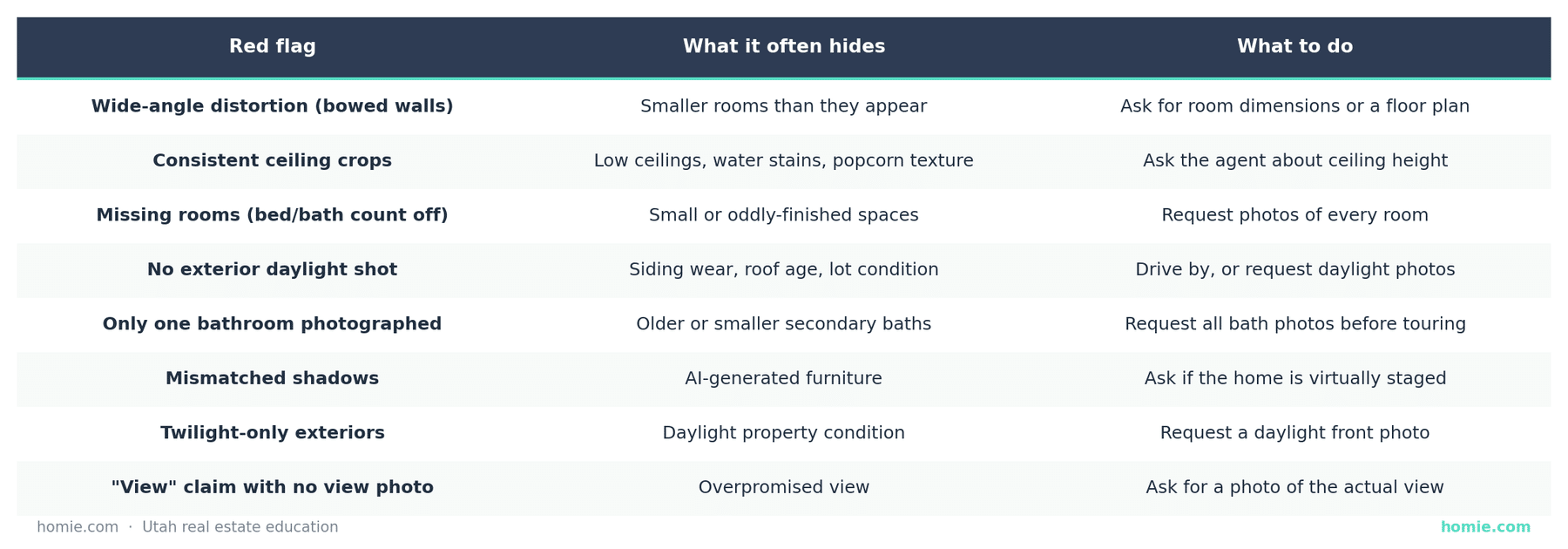
The point is not to disqualify a listing for any one item. It is to know what to ask before committing tour time.
When 3D tours and floor plans are worth the time
Matterport, Zillow 3D Home, and similar tour formats are common on Utah listings priced above $400,000 and increasingly standard above $600,000. They are useful for two specific things:
- Verifying room flow. A 3D tour shows how rooms connect, where doors open into other doors, and how the kitchen relates to the living space. Photos cannot show this reliably.
- Spotting absences. A 3D tour walks every room. If the listing description claims a basement family room and the 3D tour ends at the basement stairs, the room either does not exist or was excluded for a reason.
What 3D tours still hide: lighting in different conditions, sound from the street, smells, neighbor noise, and the actual experience of opening a window. They are a screening tool, not a tour substitute. Floor plans, when available, are the single most reliable document in a listing. They show actual square footage by room, layout, and dimensions. A listing with a published floor plan is being transparent. A listing with no floor plan and only photos may be hiding an unusual layout.
What to ask the listing agent before driving out to tour
Before scheduling a Utah home tour, a handful of questions to the listing agent (or your buyer’s agent) can save 30 minutes of driving and 60 minutes of touring on a property that will not work.
- “Are any of the listing photos virtually staged?”
- “Can you send the floor plan or room dimensions?”
- “Is there a photo of [the missing room] you didn’t include?”
- “Have any inspection reports been done in the last 12 months that the seller would share?”
- “Are there pending or recent disclosures on permits, additions, or repairs?”
- “Is the view in photo [X] the actual view from the property?”
- “What is the seller’s disclosure status on the Wasatch Front MLS?”
The agent has no obligation to answer all of these, but the responsiveness and quality of the answers tells you something about how the listing is being marketed.
Frequently Asked Questions
How can I tell if a Utah listing photo is virtually staged?
Look for mismatched shadows (furniture shadows pointing the wrong direction or softer than the room’s real shadows), warped fixtures (light fixtures that float or have impossible geometry), or texture inconsistencies (too-perfect wood grain, repeating patterns). The listing description often includes phrases like “virtually staged” or “digitally enhanced.” When in doubt, ask the listing agent.
Why are some Utah listings missing photos of bedrooms?
The most common reasons: the room is small or oddly shaped, finished poorly, currently being used as storage, or it is a “bonus room” that does not legally qualify as a bedroom (no window egress, no closet). A 4-bedroom listing with only 2 bedrooms photographed is a red flag. Ask for photos of the missing rooms.
Do Utah real estate agents have to disclose AI staging?
Wasatch Front MLS rules require photos to accurately depict the property, and virtual staging is generally permitted only if disclosed in the photo caption or listing description. Some virtual-staging tools embed metadata identifying the staging tool. The Utah Division of Real Estate has not issued formal AI-specific guidance as of 2026, but misleading visuals can constitute a disclosure violation.
Are 3D tours an adequate substitute for an in-person tour?
No. A 3D tour is a powerful screening tool for room flow, layout, and spotting absences, but it cannot capture lighting in different conditions, ambient sound, smells, or the feel of the neighborhood. Use 3D tours to decide which homes to visit, not to skip the visit entirely.
How many photos should a typical Utah single-family listing have?
A well-marketed Utah single-family listing in 2026 typically includes 25 to 45 photos covering every room, multiple exterior elevations, the yard, the garage, and at least one neighborhood-context shot. Higher-priced listings often add a twilight exterior and a drone overhead. Fewer than 15 photos on a single-family home suggests either a fast turnover listing or thin marketing.
What is the most reliable document in a Utah listing?
A published floor plan. It shows actual room dimensions, layout, and total finished square footage. A listing with a floor plan published is being transparent about the home’s geometry. A listing with no floor plan and only photos can be evaluated, but the photos alone leave room for distortion and selective angle choice.
Read the facts here:
- NAR Profile of Home Buyers and Sellers. National statistics on home-buyer search behavior, including time spent on photos.
- Wasatch Front MLS public-facing rules. Public information on photo and listing standards.
- Coalition for Content Provenance and Authenticity (C2PA). Cross-industry standard for AI image labeling and provenance.
Happy hunting. Listing photos are a sales pitch, not a documentary, and the tools have gotten a lot fancier in the last year. If you’d rather have a buyer’s agent who’ll ask the “wait, where’s the second bathroom?” question for you before you drive across the valley, that’s us at homie.com/buy, a licensed Utah brokerage. MLS rules and AI-staging norms keep moving, so verify anything time-sensitive with the Wasatch Front MLS or your agent.
— The Homie Team
*This article is for general informational purposes only and is not legal, tax, or financial advice. For guidance specific to your situation, consult a licensed professional.
*All brokerage fees, including listing and buyer agent compensation, are fully negotiable and determined solely by the seller and service provider.
*Flat-fee pricing and service availability may vary by location.
*Examples and potential savings are for illustrative purposes only.