
When you shop for a home on Utah’s rural and suburban fringe, the listing eventually mentions how the property handles wastewater, and the answer is usually one of two words: septic or sewer. It sounds like a footnote. It is not. The choice affects your inspection checklist, your closing costs, your monthly bills, and sometimes whether a lender will finance the home at all. Most national guidance on this topic skips the parts that are specific to Utah, where soil testing rules, county health-department permits, and the cost of connecting to a sewer line where one exists all change the calculus. This article explains how each system works, what a Utah septic inspection actually covers, and the specific things to verify before you write an offer on a property that is not on city sewer.
How does a septic system work, and how is it different from sewer?
A septic system treats wastewater on the property itself, while a sewer connection pipes it away to a municipal treatment plant. With septic, waste flows into a buried tank where solids settle, and the liquid then disperses through a drainfield (also called a leach field) into the soil, which does the final filtering. With sewer, the city or a special service district treats the waste off-site and bills you for the service. The practical differences show up in maintenance, cost structure, and risk. A septic system is yours to maintain and eventually replace; a sewer connection trades that responsibility for a recurring bill.
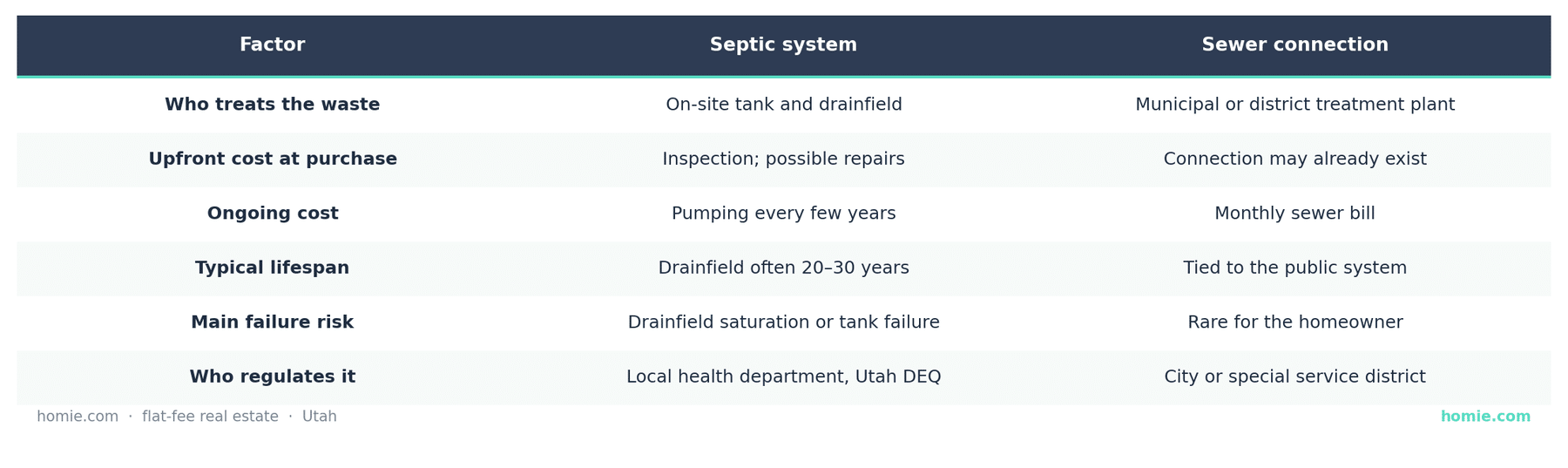
Figures and lifespans are general and vary by system, soil, and use. Verify specifics for any individual property.
What does a Utah septic inspection cover?
A septic inspection during your due-diligence window checks the tank, the drainfield, and the system’s overall condition, and it is separate from a standard home inspection. The inspector typically locates and opens the tank, measures the sludge and scum layers, checks the baffles, runs water to confirm the drainfield accepts flow, and looks for surfacing effluent or odors that signal a failing field. Ask for the pumping history and the system’s age, because a drainfield nearing the end of its life is one of the most expensive surprises in a rural purchase. In Utah, onsite wastewater systems are regulated under state rules administered through your local health department, with statewide oversight from the Utah Department of Environmental Quality’s Onsite Wastewater Program. That two-layer structure matters: the state sets the standard, but the county health department issues permits and keeps the records, so it is the office you call to confirm a system was permitted and inspected.
What is a percolation test, and when do you need one?
A percolation test (a “perc test”) measures how quickly soil absorbs water, which determines whether a property can support a septic drainfield and how large that field must be. You generally need a fresh perc test when you are building a new system, replacing a failed one, or buying raw land where no system exists yet. For an existing, functioning system, the perc test was done when the system was first permitted, so your focus shifts to confirming the current condition rather than re-testing the soil. Utah rules require that soil and percolation testing be performed by an appropriately certified individual or engineer, and the local health department is typically involved in or notified of the testing. Costs vary widely by location and site conditions.
What does it cost to connect to sewer where it exists?
If a sewer line runs to or near the property, connecting is an option, but it is not free. You typically pay a one-time connection or impact fee set by the city or special service district, plus the cost of the physical lateral from the home to the main, which depends on distance and terrain. After that you carry a monthly sewer charge. Where no main is nearby, extending sewer can be prohibitively expensive, which is exactly why septic remains common on Utah’s rural fringe. The decision is rarely septic-versus-sewer in the abstract. It is usually “this specific property has septic, and sewer is either available at a known cost or not available at all.” Get those numbers from the local district before you assume a connection is feasible.
Resale and lending considerations for septic properties
Septic does not make a home hard to sell, but it adds diligence steps that buyers and their lenders expect. Some loan programs require a satisfactory septic inspection, and occasionally a recent pumping or a clean report, before closing. A failing drainfield discovered late can delay or derail a sale, so sellers benefit from having recent service records ready, and buyers benefit from ordering the septic inspection early in the due-diligence period rather than at the last minute. For buyers comparing two otherwise similar homes, factor the lifecycle cost: septic saves the monthly sewer bill but carries periodic pumping and an eventual replacement, while sewer trades a recurring charge for one less major system to maintain.
Frequently Asked Questions
Do I need a septic inspection when buying a Utah home?
If the home is on septic, yes, order one during your due-diligence window. It is separate from the general home inspection and checks the tank, drainfield, and overall condition. Some lenders require a satisfactory septic report before closing.
How often does a septic tank need to be pumped?
Most households pump every three to five years, though the interval depends on tank size and the number of occupants. Ask the seller for the pumping history, since a long gap can signal a neglected system.
Who regulates septic systems in Utah?
Your local health department issues septic permits and keeps the records, operating under statewide rules from the Utah Department of Environmental Quality. Call the county health department to confirm a specific system was permitted and inspected.
How long does a septic drainfield last?
A well-maintained drainfield often lasts 20 to 30 years, but soil conditions, system age, and how the home uses water all affect it. A drainfield near the end of its life is a major replacement cost, so confirm the age and condition before you buy.
Is it worth connecting to sewer if it is available?
It depends on the connection and lateral cost versus the long-run cost of maintaining and eventually replacing the septic system. Get the connection fee from the local district and weigh it against the monthly sewer charge and the septic system’s remaining life.
That’s the short course on wastewater. If you’re buying on Utah’s rural edge and want a brokerage that will make sure the septic inspection actually happens inside your due-diligence window, homie.com/buy is where we work. None of the above is legal or engineering advice, so confirm permits and system condition with your county health department before you commit.
— The Homie Team
- Utah DEQ, Onsite Wastewater Program
- Utah DEQ, Wastewater Certification Permit Guide
- Southwest Utah Public Health Department, Septic Systems
- Summit County Health Department, Permitting a New Septic System
*All brokerage fees, including listing and buyer agent compensation, are fully negotiable and determined solely by the seller and service provider.
*Flat-fee pricing and service availability may vary by location and are subject to change over time. Verify current pricing before listing.
*Past performance is not indicative of future results.
*Examples and potential savings are for illustrative purposes only.