
In much of rural and suburban Utah, the rights to whatever lies beneath a property can be owned by someone other than the person who owns the surface. That split is common across the state because of its mining and energy history and its large blocks of state and federal land. National mineral-rights advice misses Utah’s specific title steps and the role of SITLA and federal severances, so a Utah buyer needs the local version. This article explains the difference between the surface and mineral estates, whether minerals convey with the deed, how to check, and what a split estate means for a surface owner.
What are mineral rights in Utah real estate?
Mineral rights are the ownership of the resources beneath a property, such as oil, gas, coal, and other minerals, and they can be owned separately from the surface land. When the two are owned by different parties, the property is called a split estate or severed estate, and buying the surface does not automatically give you what is underneath. This matters because Utah has extensive split-estate land. A buyer who assumes the deed includes everything below ground can be surprised to learn a third party holds the minerals and, in some cases, the legal right to access them.
What is the difference between the surface estate and the mineral estate?
The surface estate is the right to use the land’s surface: to build, farm, fence, and live on it. The mineral estate is the right to the resources below and, importantly, a reasonable right to access the surface to develop them.
- Surface estate: the home, the yard, the buildings, and ordinary use of the ground.
- Mineral estate: oil, gas, and minerals below, plus a legal right of reasonable surface access to extract them.
In U.S. and Utah property law the mineral estate is generally considered “dominant,” meaning the mineral owner’s reasonable right to access can take precedence over the surface owner’s preferences. That is the single most important concept for a buyer to understand before purchasing acreage where the minerals were severed long ago.
Do mineral rights transfer with the property in Utah?
Sometimes. Minerals convey with the deed only if the seller actually owns them and the deed does not reserve or except them. In Utah’s mining and energy regions, minerals were frequently severed decades ago, so a current surface deed may pass no mineral interest at all even though it looks like a complete transfer. The reliable way to know is to check the title record rather than assume. A clean-looking warranty deed does not guarantee the minerals come with it, because a prior owner may have reserved them in an earlier conveyance that still controls.
How do you check whether minerals convey?
You verify it through the title work and county records before closing, ideally during your due diligence period. There are three documents to look at:
1. The title commitment: ask the title company specifically whether mineral rights are included or excepted. Standard policies often except minerals, and the commitment will flag prior reservations.
2. The deed and its chain: review the current deed and prior deeds for any reservation or exception of minerals. A single historic reservation severs the estate permanently.
3. County recorder records: the county recorder holds the recorded conveyances; a title professional or landman can trace the mineral chain through them.
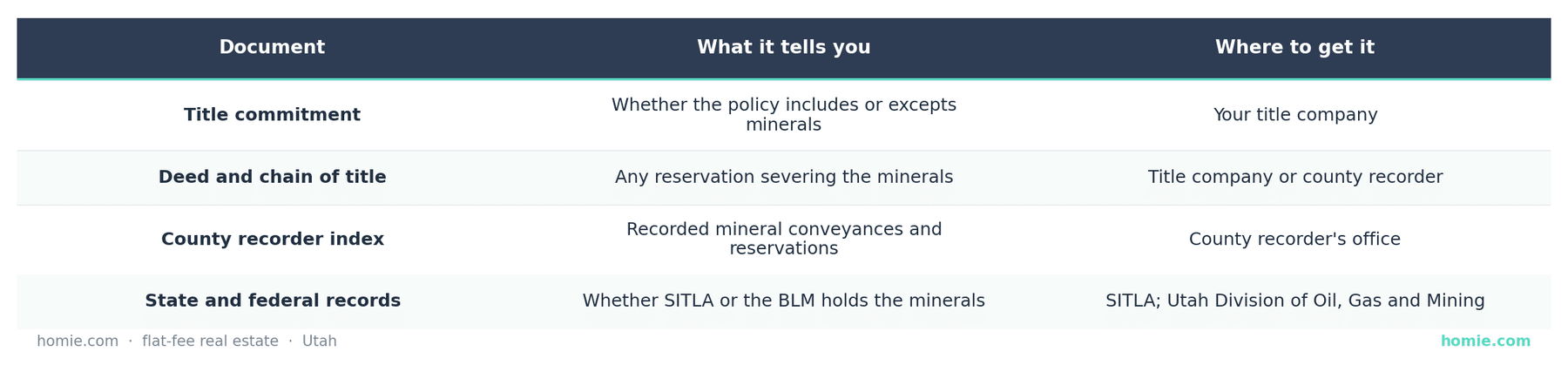
If the minerals are severed, ask the title company to identify who owns them and whether any active leases or development rights exist.
What are split estates with SITLA or federal minerals?
In Utah, the mineral owner under a split estate is often a government entity rather than a private party. The School and Institutional Trust Lands Administration (SITLA) manages state trust minerals, and the federal government, through the BLM, holds minerals under large areas of the state. A surface owner can hold a private deed while SITLA or the BLM holds the minerals below. When the minerals are state or federal, development is governed by those agencies’ leasing and access rules, and a surface owner generally cannot block reasonable access to extract them. The owner is typically entitled to compensation for surface damage, and modern rules require notice and surface-use agreements, but the surface owner does not control the decision to develop. Check whether minerals are state or federal early, because the rules differ from a private severance.
What due diligence should a Utah acreage buyer do?
Before buying land on Utah’s rural or suburban fringe, work the mineral question into your due diligence:
- Ask the seller directly whether they own the minerals and whether any are leased.
- Order title work that addresses minerals specifically, not just surface title.
- Check for active oil, gas, or mining leases through the Utah Division of Oil, Gas and Mining.
- Identify the mineral owner if the estate is severed, and ask whether a surface-use agreement exists or is likely.
- Factor access risk into your offer if development is plausible near your parcel.
Frequently Asked Questions
Can someone drill on my Utah property if they own the mineral rights?
Potentially yes. The mineral estate is generally dominant, so a mineral owner has a reasonable right to access the surface to develop. Modern Utah rules require notice and surface-use agreements and provide for surface-damage compensation, but the surface owner usually cannot veto reasonable development.
How do I find out who owns the mineral rights to my Utah property?
Start with your title company and the county recorder’s chain of title, which will show any reservation that severed the minerals. If the minerals are state or federal, check SITLA and BLM records. A landman can trace a complex chain.
Are mineral rights usually included when you buy a home in Utah?
In built-up subdivisions, mineral development is often unlikely even when minerals were technically severed. On rural acreage and in mining or energy regions, severance is common and worth verifying. Never assume; check the title.
What does it mean if my title policy “excepts” minerals?
It means the title insurance does not cover the mineral estate, which usually signals the minerals may be severed or were never examined. Ask the title company to clarify ownership before you rely on the surface deed.
Does Utah require disclosure of severed mineral rights?
Title work and the title commitment are the practical disclosure mechanism, and a Utah real estate professional should flag the question on rural land. The recorded chain of title is the controlling record, so verify it rather than relying on a checkbox.
That’s the short course on what’s under the dirt in Utah. If you’re buying acreage on the rural fringe and want a brokerage that will push the mineral question during due diligence instead of after closing, homie.com/buy is where we work. None of this is legal advice; for a severed estate or an active lease, get a Utah real estate attorney or a landman in the conversation early.
— The Homie Team