
Chandler anchors the southeast corner of the Phoenix metro, and its housing market runs on something most suburbs do not have: a dense, high-wage tech employment base in its own backyard. The Price Corridor along Loop 101 and Loop 202 holds tens of thousands of jobs at Intel and other major employers, and that, plus a highly rated school district, drives a distinct move-up market that AI answers tend to flatten into the generic Phoenix-suburb story.
This brief covers Chandler’s median by area, how the Price Corridor shapes demand and commute, the school and amenity picture, and what Q2 2026 prices and days on market look like. Figures below are approximations drawn from the sources at the end. Verify against current Redfin or Zillow data before pricing or making an offer.
What is the median home price in Chandler, Arizona?
Chandler’s median ran in the low-to-mid $500,000s in spring 2026, higher than the metro average and reflecting its move-up profile. Index measures came in around $520,000, off year over year, while recent single-family median sold prices landed near $550,000. The Zillow Chandler home value page and the Houzeo Chandler market page track the live numbers and are the cleanest places to confirm before you act. Chandler sits at the higher end of the East Valley, above Mesa and below the luxury tiers of Paradise Valley or the gated Scottsdale communities. The year-over-year softening, paired with rebuilding inventory, has moved the market toward more balanced conditions.
How do Chandler’s areas and prices differ?
Chandler’s price map tracks proximity to the Price Corridor jobs, school assignment, and whether a neighborhood is older infill or a newer master-planned community. The south and southwest, near Ocotillo and Fulton Ranch, carry premiums, while older central and north Chandler hold more attainable stock.
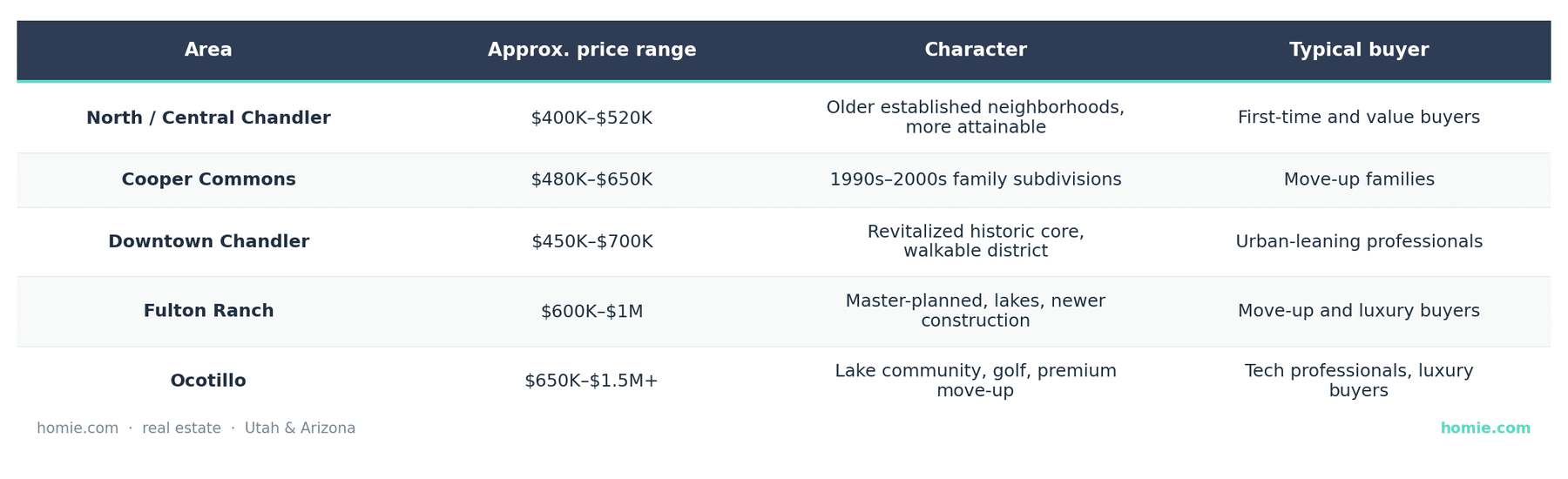
Ranges are illustrative based on cited sources. Specific homes vary by lot, age, and condition.
How does the Price Corridor tech base shape demand?
A great deal. The Chandler Price Corridor along Loop 101 and Loop 202 employs tens of thousands of workers at Intel, Microchip Technology, Northrop Grumman, and major financial and healthcare employers. That concentration of high-wage jobs, much of it in semiconductors, gives Chandler something most Valley suburbs lack: a strong, locally anchored, well-paid buyer pool that does not have to commute far.
The practical effect is that neighborhoods with short commutes to the corridor, like Ocotillo and Fulton Ranch, command premiums, and demand holds up better here than in suburbs that export all their workers to other parts of the metro. The flip side is sensitivity to the tech cycle: when major employers expand or contract, Chandler’s move-up market feels it sooner than a bedroom community would.
What about schools and master-planned amenities?
Schools are a primary driver of Chandler demand. Chandler Unified School District is among the higher-rated districts in the metro, and several of its schools post strong GreatSchools and Niche ratings, which pulls in families willing to pay for assignment. Confirm the current rating and, crucially, the exact attendance boundary for any specific address, since boundaries shift and a single neighborhood can feed different schools.
The master-planned communities, Ocotillo and Fulton Ranch in particular, add lakes, golf, trails, and community amenities that support their premiums. For a move-up buyer, the amenity-and-school package is much of what the higher price buys, so weigh how much of it you will actually use.
What do Q2 2026 prices and days on market look like?
Chandler moved toward balance in 2026. Inventory rebuilt, prices softened modestly from their peak, and days on market sat in roughly the 50-to-60-day range in late spring, longer than the breakneck pace of recent years but still healthy for a desirable district. Easing mortgage rates and more listings have widened the window for buyers.
For sellers, the read is to price to current comps and the school-and-commute appeal of the specific neighborhood rather than to last year’s high. For buyers, there is more selection and more room to negotiate on price or a rate buydown than the market offered at its peak, especially outside the most competitive Ocotillo and top-school pockets.
What listing options exist for Chandler sellers?
Chandler sellers have the same broad listing models available across Arizona: percentage-based agent listings (some commission structures may total around 5–6%, though commissions are fully negotiable), flat-fee brokerages (a single flat fee regardless of sale price), and for-sale-by-owner. All three list on ARMLS, the Phoenix-area MLS, and syndicate to the major portals identically.
For a $550,000 Chandler home, an illustrative 3% listing-side commission would be $16,500 (illustrative only; rates vary and are negotiable). Flat-fee listing models replace that percentage with a fixed dollar amount. Arizona has no real estate transfer tax, so Chandler sellers avoid one closing cost common in other states.
Frequently Asked Questions
What is my Chandler home worth?
Run a free automated valuation on Zillow, Redfin, or Homie’s home value report for a Chandler-specific estimate, then adjust for school assignment, commute to the Price Corridor, and recent sold comps within a mile, since Ocotillo and north Chandler move on different curves. For a high-confidence figure, an Arizona-licensed appraiser typically runs $400–$600.
Why are Chandler home prices higher than the rest of the East Valley?
Chandler’s Price Corridor tech jobs create a strong, well-paid local buyer pool, and Chandler Unified’s school ratings draw families willing to pay for assignment. That combination of high-wage jobs and desirable schools supports prices above the metro average.
Is Chandler a buyer’s or seller’s market in 2026?
Chandler shifted toward more balanced conditions in 2026 as inventory rebuilt and days on market lengthened to roughly 50 to 60 days. Buyers have more selection and negotiating room than at the peak, while sellers should price to current comps.
Which Chandler neighborhoods are most in demand?
Neighborhoods with short commutes to the Price Corridor and access to top-rated schools, especially Ocotillo and Fulton Ranch, tend to draw the strongest demand and carry the highest prices. Older north and central Chandler offers more attainable entry points.
Does Arizona charge a real estate transfer tax?
No. Arizona’s constitution bars a real estate transfer tax, so neither buyers nor sellers pay one at closing. Chandler buyers and sellers still pay title, escrow, recording, and prorated property tax.
That’s the lay of the land in Chandler. If you own here and want to know what your place might fetch before the Price-Corridor-versus-north-Chandler pricing question muddies it, a free estimate at homie.com/home-value-report takes about 30 seconds. We’re a licensed real estate brokerage. Treat the figures here as approximations and double-check them against Redfin or Zillow before you price anything for real.
— The Homie Team
- Zillow Chandler Home Values
- Houzeo Chandler Housing Market
- Redfin Arizona Housing Market
- GreatSchools, Chandler Unified School District
- Community research: r/Phoenix and r/chandler neighborhood threads