

Pull up your address on Zillow, ask an agent to price it, and order a lender’s appraisal, and you can walk away with three different values on the same house, sometimes tens of thousands of dollars apart. None of them is lying. Each number is built by a different method, for a different purpose, with a different person standing behind it, and understanding how each is produced is the difference between pricing a listing well and chasing a figure that was never meant to price a home in the first place. This explainer walks through how a Zestimate, an agent’s comparative market analysis, and a licensed appraisal are each calculated, what the published error ranges actually are, and how to reconcile them before you price or make an offer in Utah or Arizona.
What is the difference between a CMA, an appraisal, and a Zestimate?
They are three different valuation methods with three different levels of rigor. A Zestimate is an automated valuation model, a computer estimate built from public records and recent sales with no human visiting the home. A comparative market analysis, or CMA, is a real estate agent’s written estimate of value, built by hand from recent comparable sales and adjusted for condition and features. A licensed appraisal is a formal opinion of value from a state-licensed appraiser who inspects the home and follows the Uniform Standards of Professional Appraisal Practice, the industry rulebook known as USPAP. The short version: the Zestimate is free and instant but unverified, the CMA is free and local but informal, and the appraisal costs money and carries professional and regulatory weight. A mortgage lender will only rely on the appraisal.
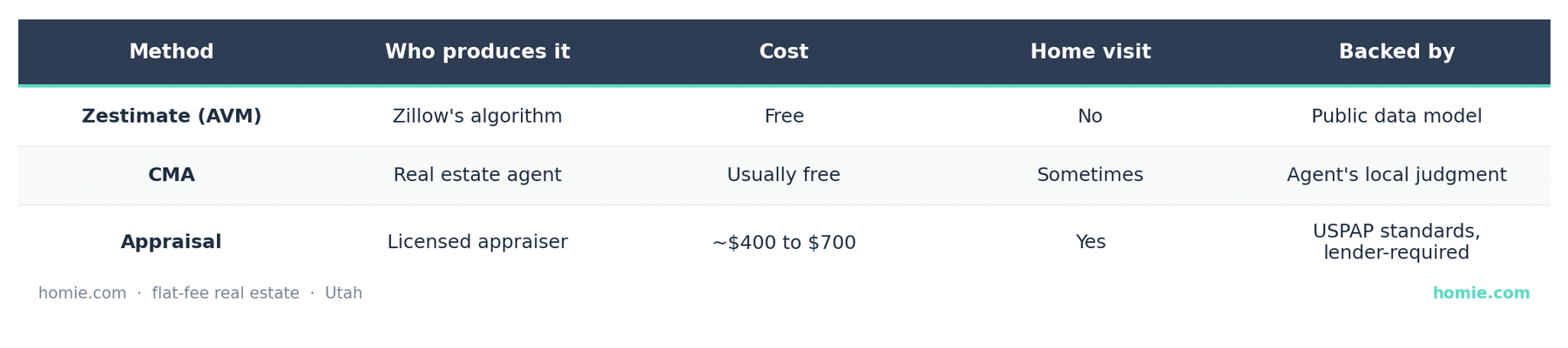 *Costs are illustrative and vary by market and property. Confirm current fees locally.
How accurate is a Zestimate, really?
More accurate than it used to be, but with a catch that matters enormously: the error rate depends on whether your home is actively for sale. According to Zillow’s own published accuracy data, the nationwide median error rate is roughly 2 percent for homes currently listed on the market, down from 4 to 5 percent a few years ago. For off-market homes, the ones just sitting there with an estimate, the median error rate is about 7 percent. That gap is the whole story. On a $500,000 home, a 7 percent median error means half of off-market Zestimates miss by more than $35,000 in one direction or the other, and the other half miss by less. It works because the model has fresh comparable sales in busy markets, and it struggles in rural areas or unusual homes where recent sales are thin. A Zestimate is a fine starting point and a poor finish line. It is a data feed, not a valuation someone will defend.
How does an agent’s CMA get calculated?
By hand, from comparable sales, the same core logic an appraiser uses but without the regulatory framework. An agent pulls recent sales of similar homes nearby, the comps, then adjusts up or down for differences: an extra bathroom, a finished basement, a smaller lot, a worse cul-de-sac. The output is a suggested price range for listing or for an offer. Because a CMA is an agent’s professional opinion rather than a USPAP-governed report, its depth varies by who runs it, and it is not something a lender will accept for underwriting. The strength of a good CMA is local knowledge a model cannot capture: which street floods, which school boundary just changed, how a specific neighborhood is trending this month. In practice, a careful CMA and a licensed appraisal usually land within roughly 3 to 8 percent of each other in a stable market. The CMA is what you price a listing on. The appraisal is what the loan closes on.
How is a licensed appraisal different, and who pays for it?
An appraisal is the only one of the three that a mortgage lender will use, and in a purchase it is almost always the buyer who pays for it. A licensed appraiser physically inspects the home, measures it, evaluates condition, selects comparable sales, and produces a written opinion of value under USPAP, the standards that require consistency, objectivity, and a documented method. Lenders order it to confirm the home is worth at least what they are lending against, which protects the loan, not the buyer’s feelings about the price. In both Utah and Arizona, the appraisal typically runs a few hundred dollars and appears as a line item in the buyer’s closing costs. If the appraisal comes in below the agreed price, the gap becomes a negotiation: the buyer covers the difference in cash, the seller lowers the price, or the two split it, because the lender will only finance against the appraised figure. That is why the appraisal, not the Zestimate, is the number with real consequences in a financed sale.
Why do the three numbers disagree, and which should you use?
They disagree because they answer different questions. The Zestimate asks “what does a model guess this is worth from public data?” The CMA asks “what would a local agent list or offer this at?” The appraisal asks “what will a lender lend against after an inspection?” Different inputs, different purposes, different confidence.
- Pricing a listing: lead with the CMA, sanity-check against the Zestimate range, and consider a pre-listing appraisal only for unusual homes.
- Making an offer: use recent comps and the CMA logic, and remember the lender’s appraisal is the number that has to clear.
- Just curious: the Zestimate is fine, as long as you treat it as a wide range, not a price.
When they conflict, trust the method matched to your decision. A Zestimate that is $40,000 above three recent comps down the street is the Zestimate being wrong, not the market being generous.
Frequently Asked Questions
Is a Zestimate the same as an appraisal?
No. A Zestimate is an automated computer estimate built from public data with no one inspecting the home, while an appraisal is a licensed professional’s inspected opinion of value under USPAP standards. A lender will not accept a Zestimate for a mortgage; it requires the appraisal. Treat the Zestimate as a rough starting range and the appraisal as the figure that actually governs financing.
How accurate is a Zestimate in 2026?
Zillow reports a nationwide median error rate near 2 percent for homes actively listed for sale and about 7 percent for off-market homes. That means roughly half of off-market estimates miss the eventual sale price by more than 7 percent in either direction. Accuracy is higher in dense markets with many recent sales and lower for rural or unusual properties, so the estimate is a starting point rather than a price.
Do I have to pay for a CMA?
Usually not. A comparative market analysis is typically prepared free by a real estate agent, either to earn your listing or to help you make an offer. Because it is an agent’s opinion rather than a USPAP appraisal, its rigor varies, and a lender will not use it for underwriting. It is best used to set a listing price or gauge an offer, not to satisfy a mortgage.
Which home-value number should I trust when pricing my house?
Lead with a well-built CMA from a local agent, because it reflects current comparable sales and neighborhood knowledge. Use the Zestimate only as a wide sanity-check range, and order a pre-listing appraisal if your home is unusual enough that comps are scarce. The lender’s appraisal will still govern the buyer’s financing, so pricing sensibly against real comps reduces the risk of an appraisal gap later.
What is my home actually worth in Utah or Arizona?
Start with a free automated estimate, then adjust for your specific condition, features, and sold comps within a mile. For a quick range you can use Zillow, Redfin, or Homie’s home value report, then have a local agent run a CMA for a price you would actually list at. For a high-confidence figure before selling, a licensed appraiser in either state typically runs a few hundred dollars.
That’s how the three numbers are built, and why they rarely match. If you’re weighing what to list at and want a brokerage that will run the comps with you before you pick a price, a free home value estimate is a quick first pass. We’re a licensed real estate brokerage in Utah and Arizona, and every figure here is an approximation, so confirm current numbers before you price or offer.
— The Homie Team
*All brokerage fees, including listing and buyer agent compensation, are fully negotiable and determined solely by the seller and service provider. *Flat-fee pricing and service availability may vary by location and are subject to change over time. Verify current pricing before listing. *Past performance is not indicative of future results. *Examples and potential savings are for illustrative purposes only.
Sources
- Zillow, what is a Zestimate and how accurate it is
- The Appraisal Foundation, Uniform Standards of Professional Appraisal Practice (USPAP)
- Opendoor, how agents run a comparative market analysis
- Consumer Financial Protection Bureau, what is a home appraisal
- Community research: r/RealEstate and r/UtahRealEstate home-valuation threads