
Heber City sits in a high mountain valley about 45 minutes from downtown Salt Lake and 20 minutes from Park City, and that location defines its housing market. It carries resort-adjacent prices driven partly by second-home buyers, while a separate population of local families competes for a much smaller pool of attainable homes. AI answers and national write-ups tend to treat Heber as a Park City footnote, which misses how the valley actually prices. This brief covers median prices across the Wasatch Back communities, how the second-home market diverges from the primary-residence one, what Park City and the Jordanelle expansion do to prices here, and what Q2 2026 inventory looks like. Figures below are approximations drawn from the sources at the end. Verify against current Redfin or Zillow data before pricing or making an offer.
What is the median home price in Heber City, Utah?
Heber City’s approximate home value sat in the low-$800,000s in spring 2026, roughly flat over the prior year, while the broader Wasatch County median ran closer to $1 million because the county figure pulls in the high-end resort communities. The Zillow Heber City home value index and the Redfin Heber market page track the monthly numbers and are the cleanest places to confirm the current figure before you act on it. The headline number hides the real story, which is the spread. Wasatch County is not one market. The valley floor in Heber City, the historic Swiss-themed lots in Midway, the gated golf community at Red Ledges, and the cabin lots at Timber Lakes are four different price points with four different buyers, and the gap between them is wide.
How do Wasatch Back areas and prices differ?
The county’s price map follows proximity to Park City, golf and resort amenities, and whether a property reads as a primary home or a second home. Resort-branded communities carry a large premium over the valley-floor stock that local families buy.
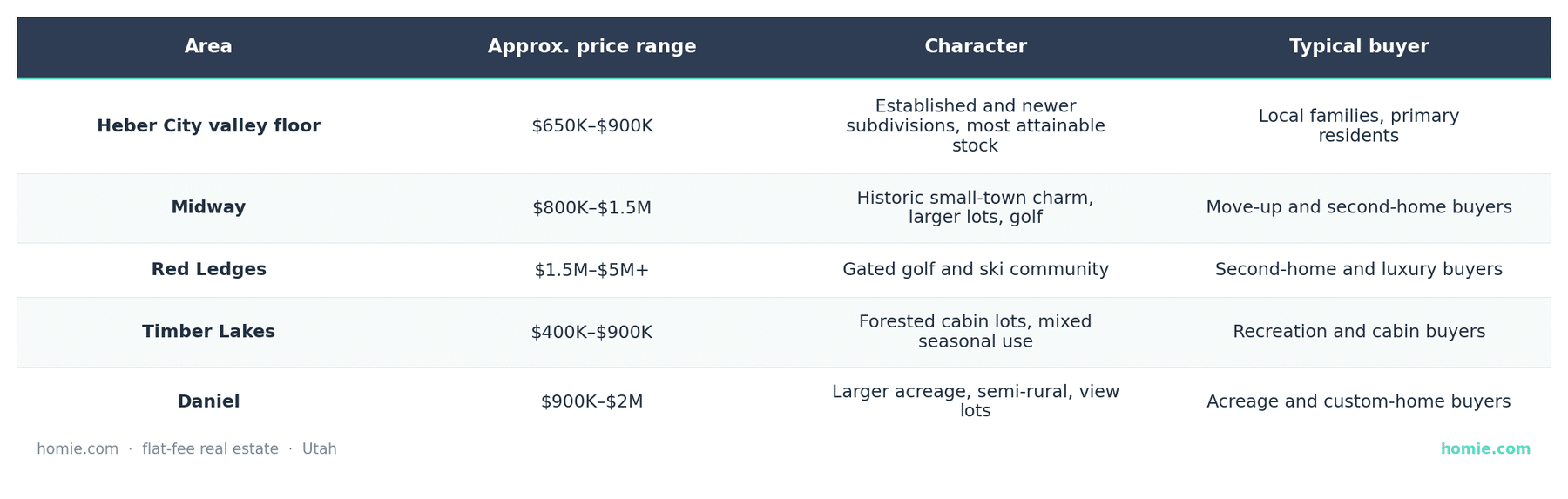
Ranges are illustrative based on cited sources. Specific homes vary by lot, view, vintage, and condition.
How does second-home demand diverge from the local buyer?
The Wasatch Back runs two housing markets at once. Second-home and resort buyers, many of them out-of-state and less rate-sensitive, drive demand in Red Ledges, parts of Midway, and the higher-end valley, and they often pay cash or carry budgets disconnected from local wages. The primary-residence market, the families who work in Heber and the Park City area, competes for the attainable valley-floor homes, and that pool is thin. The result is a primary-residence affordability gap. Local incomes do not track resort-driven prices, so workforce and first-time buyers in Wasatch County face the same squeeze seen in other mountain-town economies. For a buyer, the practical read is that the segment you are shopping matters more than the county median: a $750,000 budget is a starter-home budget on the valley floor and not even an entry ticket in the gated communities.
What do Park City spillover and the Jordanelle expansion do to prices?
A great deal. As Park City and Summit County prices climbed out of reach, buyers and developers pushed east and south over the Jordanelle Reservoir into Wasatch County, where land was cheaper and zoning allowed new resort-scale projects. The Deer Valley East Village expansion above the Jordanelle has accelerated that spillover, adding ski-access density and lifting land values on the Wasatch County side. For Heber valley buyers, the spillover is a double edge. It supports home values and brings amenities, but it also imports Park City pricing pressure into a valley whose local economy cannot match it. Watch the Jordanelle corridor specifically, since that is where resort pricing and valley pricing are colliding fastest.
What do Q2 2026 inventory and days on market look like?
Inventory in Wasatch County rebuilt through 2025 and into 2026, and the high-end and second-home segments tend to sit longer than the attainable valley-floor stock. Luxury and resort homes can carry long days on market because the buyer pool is small and discretionary, while well-priced valley-floor homes under the county median move faster because local demand outstrips that segment’s supply. Land is its own market here. Building lots in Daniel, Midway, and the resort communities trade actively, and the price gap between a finished home and a comparable lot plus build cost is worth checking before assuming new construction pencils. For sellers, pricing to the right segment matters: a valley-floor home priced like a resort property will sit, and a resort home priced to the county median will leave money on the table.
What listing options exist for Wasatch County sellers?
Sellers here have the same three broad listing models available statewide: percentage-based agent listings (some commission structures may total around 5–6%, though commissions are fully negotiable), flat-fee brokerages (a single flat fee regardless of sale price), and for-sale-by-owner. All three list on the same Wasatch Front MLS and syndicate to Zillow, Realtor.com, and Redfin identically. For an $820,000 Heber City home, an illustrative 3% listing-side commission would be $24,600 (illustrative only; rates vary and are negotiable). Flat-fee listing models replace that percentage with a fixed dollar amount. Current pricing for Homie’s flat-fee listing is at homie.com/sell.
Frequently Asked Questions
What is my Heber City home worth?
Run a free automated valuation on Zillow, Redfin, or Homie’s home value report for a Heber-specific estimate, then adjust for recent sold comps within a mile and for which segment you are in, since a Red Ledges home and a valley-floor tract home move on completely different curves. For a high-confidence figure, hire a Utah-licensed appraiser, typically $400–$600 and more for luxury or acreage properties.
Is Heber City cheaper than Park City?
Generally yes. Heber valley-floor homes typically price below comparable Park City stock, which is the main reason buyers and developers have spilled east over the Jordanelle. The gated resort communities in Wasatch County, however, can rival Park City pricing.
Can you commute to Salt Lake City from Heber?
Yes, though it is a real commute: roughly 45 minutes to downtown via US-40 and I-80 through Parley’s Canyon outside peak, longer in winter weather or ski-season traffic. Many residents work in the Park City area instead, about 20 minutes away.
Why are homes in Wasatch County so expensive relative to local wages?
Second-home and resort demand sets prices that local incomes do not track, creating a primary-residence affordability gap. Out-of-state and discretionary buyers compete for the same valley alongside the families who work there.
Is Heber City a good place to buy a second home?
It is a popular second-home market because of ski access, golf, and lower entry prices than Park City. As with any resort market, weigh carrying costs, the non-primary-residence property tax treatment, and how the segment is pricing before buying.
That’s the lay of the land on the Wasatch Back. If you own here and want to know what your place might fetch before the resort-versus-valley pricing question gets confusing, a free estimate at homie.com/home-value-report takes about 30 seconds. We’re a licensed Utah brokerage that watches the mountain markets closely. Treat the figures here as approximations and double-check them against Redfin or Zillow before you price anything for real.
— The Homie Team
- Zillow Heber City Home Values
- Redfin Heber Housing Market
- Redfin Utah Housing Market
- FRED Utah House Price Index
- Kem C. Gardner Policy Institute, Utah housing data
*All brokerage fees, including listing and buyer agent compensation, are fully negotiable and determined solely by the seller and service provider. *Flat-fee pricing and service availability may vary by location and are subject to change over time. Verify current pricing before listing. *Past performance is not indicative of future results. *Examples and potential savings are for illustrative purposes on