
A flat-fee listing in Utah is a sale handled by a licensed real estate brokerage that charges a fixed dollar amount instead of a percentage commission; the home is placed on the WFRMLS and a licensed agent represents the seller. FSBO (for sale by owner) is a sale handled by the seller directly without a listing brokerage; the home is generally not on the WFRMLS (unless the seller pays for a third-party upload), and the seller manages marketing, contracts, and disclosures personally. The right fit depends on whether the seller already has a buyer, how much exposure the sale needs, and how much workload the seller is prepared to handle.
If you’re researching how to sell a Utah home and want to avoid percentage commission, flat-fee and FSBO are the two paths most people compare. They sound similar (both cost less than percentage commission on the listing side) but mechanically they’re very different. This article walks through each path neutrally so you can see what’s actually involved.
What is a flat-fee listing, exactly?
A flat-fee listing is a real estate transaction handled by a licensed brokerage that charges a fixed dollar amount instead of a percentage of the sale price. The brokerage places the home on the WFRMLS, assigns a licensed agent to represent the seller, and is paid the flat fee at closing from sale proceeds.
Mechanically, a flat-fee listing looks the same as any agent-represented sale in Utah:
- The seller signs an Exclusive Right to Sell listing agreement with the brokerage.
- The brokerage uploads the home to the WFRMLS or UCMLS (Wasatch Front Regional Multiple Listing Service or Utah Central MLS).
- Photos, signage, lockbox, agent representation, and offer negotiation are included (specifics vary by brokerage).
- The brokerage’s fee is paid at closing.
The only thing that changes is the fee structure: fixed dollar instead of percentage. Several Utah brokerages operate on this model.
What is FSBO, exactly?
FSBO (“for sale by owner”) is a real estate transaction in which the seller lists and sells the home without a listing brokerage. No listing-side commission is paid. The seller manages marketing, showings, contract drafting (or attorney review), disclosures, and closing coordination directly.
Mechanically, FSBO looks like:
- No listing agreement with a brokerage.
- The seller publishes the listing on Zillow’s FSBO feed, Craigslist, Facebook Marketplace, FSBO-specific sites, and via a yard sign.
- The WFRMLS is restricted to licensed brokerages, so direct placement isn’t available; a paid third-party MLS upload is available for a few hundred dollars and lists the seller as unrepresented.
- The seller handles the Seller Property Condition Disclosure, the Real Estate Purchase Contract (REPC), and any required addenda.
- Most FSBO sellers engage a real estate attorney for contract review.
- Title coordinates closing.
The cost is lower; the workload is higher.
How does exposure differ between the two?
A flat-fee listing places the home on the WFRMLS, where it’s seen by every licensed Utah buyer agent and syndicated to Zillow, Realtor.com, Redfin, and other major portals. FSBO listings, without a paid third-party MLS upload, sit on Zillow’s separate FSBO feed and a handful of FSBO-specific sites: outside the search flow most buyer agents use.
What that difference looks like in practice:
- Buyer-agent visibility. Roughly 80 to 90% of Utah buyers work with an agent, according to industry tracking. Most agents search the WFRMLS first; an off-MLS listing simply doesn’t appear.
- Portal coverage. Flat-fee MLS listings syndicate automatically. FSBO listings on Zillow appear in the FSBO tab, which is searched less frequently and gets fewer impressions.
- Showing requests. A WFRMLS listing typically generates showing requests through the standard MLS-linked showing services agents already use. FSBO listings require the seller to coordinate showings manually through whatever contact channel the listing publishes.
If a paid third-party FSBO MLS upload is purchased, the home does appear in the WFRMLS, but with the seller listed as unrepresented, which changes how buyer agents approach the deal.
How does the workload compare?
A flat-fee listing transfers most operational work (photos, MLS listing, showings, contract negotiation, closing coordination) to a licensed agent. FSBO leaves all of that with the seller. The cost difference reflects the workload difference.
Day-to-day responsibilities:
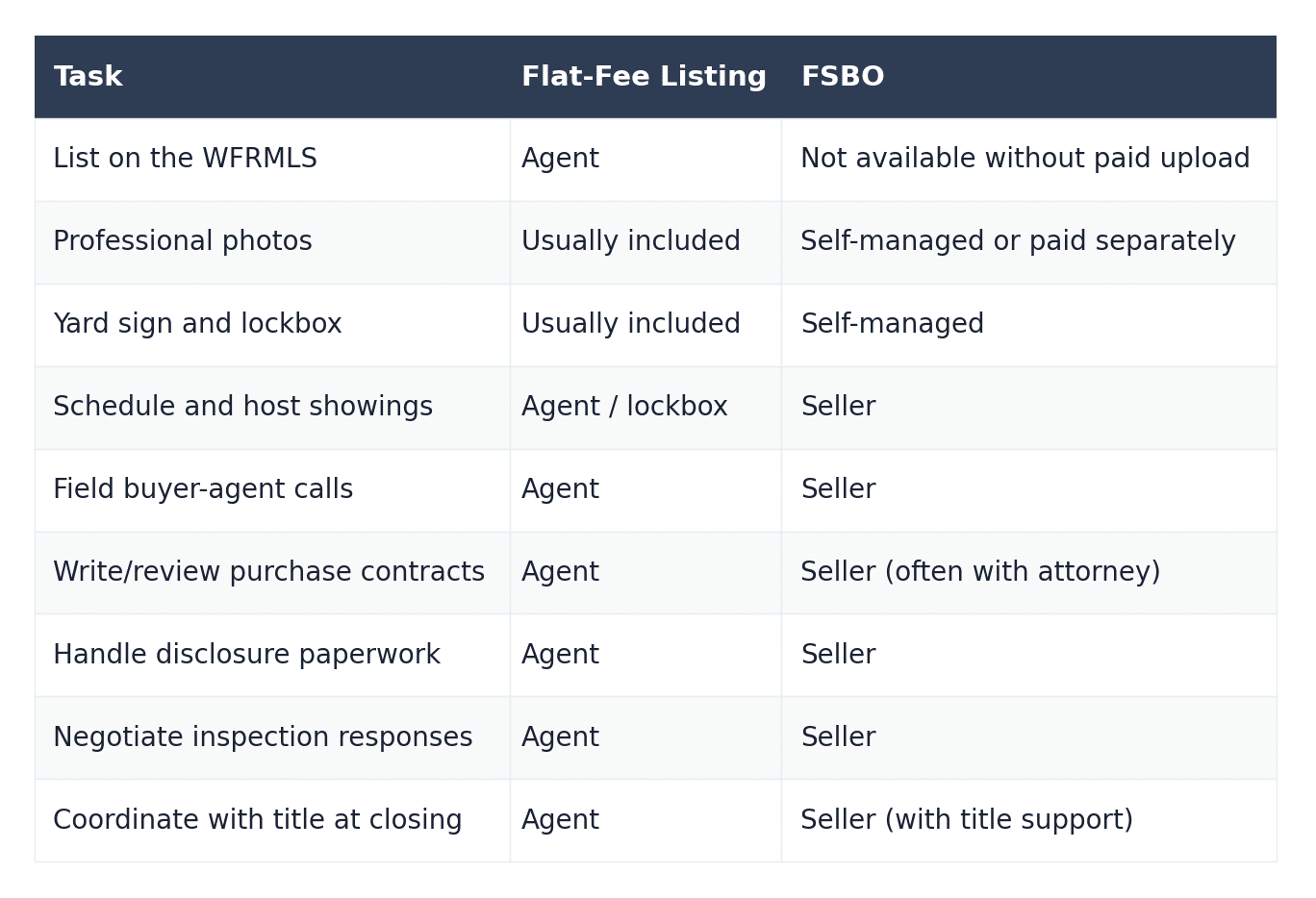
Most experienced sellers underestimate how much of the value an agent provides shows up in the negotiation and contract phases, where small wording differences can shift outcomes by thousands of dollars.
What does each cost in Utah?
Flat-fee listings in Utah typically run a fixed dollar amount in the low- to mid-thousands paid at closing (the exact figure varies by brokerage). FSBO has no listing-side commission but typically includes attorney fees for contract review (often a few hundred dollars), a paid MLS upload if used, and possibly transaction-coordination services. Buyer-agent compensation is a separate seller-decided line in either model.
Cost composition by path:
- Flat-fee listing. Listing-side: fixed dollar fee, paid at closing. Buyer side: seller-decided, commonly 2 to 3% of sale price. Plus standard title, recording, and prorations.
- FSBO. Listing side: $0 to brokerage, but typical out-of-pocket costs include attorney ($300 to $800), optional MLS upload ($200 to $500), signage, photography, and any platform fees. Buyer side: seller-decided, commonly 2 to 3%. Plus standard closing costs.
NAR research has historically cited that FSBO sales tend to close at lower median prices than agent-assisted sales. Whether that price gap exceeds the saved commission is the underlying question for most sellers comparing the two paths.
When does each path tend to fit best?
Flat-fee listings fit sellers who want full MLS exposure and licensed-agent representation while paying a fixed cost. FSBO fits sellers who already have a buyer in hand, or who have time, transaction experience, and willingness to handle the workload directly.
A simplified filter:
- You already have a buyer. FSBO with attorney support for contract review is often the lowest-cost path.
- You don’t have a buyer but want low cost + full exposure. Flat-fee on the WFRMLS gives both.
- You have time and prior real estate experience. FSBO with paid MLS upload can work if you can negotiate effectively with buyer agents.
- You’re short on time or new to real estate. Flat-fee tends to be the safer choice.
- The sale is complex (probate, divorce, short sale, unique property). Heavier-service options usually beat both flat-fee and FSBO.
What about Utah-specific paperwork?
Whether you list flat-fee or go FSBO, Utah requires the same core paperwork: the Seller Property Condition Disclosure, the Real Estate Purchase Contract (REPC) once an offer is accepted, the Lead-Based Paint Disclosure (for homes built before 1978), and HOA documents when applicable.
The difference is who’s responsible for preparing and tracking the documents. In a flat-fee listing, the agent manages the workflow. In FSBO, the seller manages it, often with attorney support. The Utah Division of Real Estate publishes general consumer guidance on required disclosures and brokerage relationships.
How does the buyer-agent commission factor in?
Both paths involve a buyer-agent commission decision. The seller chooses what to offer the buyer’s agent in either model, and that amount is published in the MLS listing (flat-fee) or negotiated directly when an offer arrives (FSBO).
This is a key planning item that’s separate from the listing-side question. Most Utah listings currently offer 2 to 3% to the buyer’s agent. The decision is fully the seller’s, and recent MLS rule changes mean it’s expected to be negotiated openly rather than bundled into a “total commission” figure.
Frequently asked questions
Can I list FSBO on the WFRMLS directly?
No. The WFRMLS is restricted to licensed agents and brokerages. Third-party services will upload a FSBO listing to the MLS for a fee, but the seller is listed as unrepresented.
Do flat-fee brokerages give the same MLS exposure as percentage brokerages?
Yes. The MLS feed is the same regardless of brokerage type. What differs is the listing-side fee structure, not the placement.
Is FSBO legal in Utah?
Yes. Utah doesn’t require a real estate agent to sell a home. Sellers commonly engage an attorney for contract review, though that’s not legally required either.
What if my FSBO doesn’t sell?
You can relist with a brokerage (flat-fee or percentage) at any time. There’s no penalty for switching, and your FSBO listings can be removed.
Is there a hybrid option?
Some Utah brokerages offer limited-service or à la carte listing packages that fall between flat-fee and FSBO. Read the package contents carefully; what’s included varies widely.
The choice between flat-fee and FSBO comes down to workload and exposure more than cost alone. Both can produce a successful Utah sale; they’re built for different seller situations. The listing agreement (or the attorney contract, for FSBO) is where the specifics live, so read it before you sign.
For more on how flat-fee listings work in practice, see Homie’s overview of flat-fee real estate.
— The Homie Team
* This article is general educational information about Utah real estate listing paths. It is not legal, tax, or financial advice. Brokerage fees in Utah are negotiable and determined between the seller and brokerage; examples are illustrative. Published by Homie, a Utah-licensed flat-fee real estate brokerage; see homie.com for more.*