
Utah sellers generally choose between three listing paths: percentage commission (a brokerage charges a percentage of the sale price, typically around 3% to the listing side), flat-fee listings (a brokerage charges a fixed dollar amount instead of a percentage), and for-sale-by-owner (FSBO, where the seller lists independently and pays no listing-side commission). Each model has different cost structures, exposure profiles, and workload distribution; the right fit depends on the home’s price tier, the seller’s time, and how much representation the seller wants.
If you’ve spent any time researching how to sell a Utah home, you’ve probably noticed that the listing-fee conversation is messy. Some sources lead with “save thousands on commission” angles; others insist FSBO costs the seller more in the end. The reality is more boring and more useful: each model has clear mechanics and trade-offs, and the right call depends on your specifics.
What is a listing fee, exactly?
This split is important. When people say “5 to 6% commission,” they usually mean the combined listing-side + buyer-side compensation. The two are independent. The listing fee covers your brokerage; the buyer-agent compensation is what you, the seller, choose to offer the buyer’s agent to bring an offer.
Since 2024 MLS rule changes following the National Association of Realtors settlement, the buyer-agent compensation is increasingly negotiated separately and disclosed openly. The Utah Division of Real Estate and the Utah Association of Realtors publish current guidance.
Model 1: Percentage commission
How percentage commission works in Utah:
- Listing agreement. The seller signs an Exclusive Right to Sell agreement specifying the listing-side commission percentage and the listing period.
- MLS placement. The home is placed on the WFRMLS or UCMLS and syndicated to Zillow, Realtor.com, Redfin, etc.
- Service inclusions. Most percentage-commission listings include professional photos, signage, lockbox, agent representation, offer negotiation, and closing coordination.
- Payment. The fee is collected from the seller’s proceeds at closing by the title company.
When percentage commission tends to fit best:
- Sellers who want maximum hands-on agent involvement.
- Higher-complexity sales (probate, divorce, unique properties) where the marginal value of dedicated agent time is highest.
- Sellers who prefer paying based on outcome (the fee is only owed if the home closes).
When it can feel expensive:
- High price tiers, where the percentage scales rapidly. A 3% listing-side fee on a $900,000 home is $27,000.
Model 2: Flat-fee brokerage
How flat-fee listings work in Utah:
- Listing agreement. Same Exclusive Right to Sell structure, except the listing-side fee is a dollar amount rather than a percentage.
- MLS placement. Identical to percentage-commission listings — full WFRMLS or UCMLS placement with portal syndication.
- Service inclusions. Vary by brokerage. Some include the same package as percentage models (photos, signage, full agent service); others operate on a base-plus-upgrades structure.
- Payment. Collected from seller proceeds at closing.
Several Utah brokerages operate on flat-fee models — Homie is one example, and other regional brokerages offer similar structures. Service depth and what’s included for the flat fee varies, so the listing agreement is worth reading line-by-line.
When flat-fee tends to fit best:
- Mid- and higher-priced homes, where the dollar-cost gap versus percentage commission is most meaningful.
- Sellers who want full MLS exposure and agent representation but prefer a predictable, fixed cost.
- Markets where the seller already has a clear pricing strategy and needs help on marketing and contract execution.
When it can feel limiting:
- Lower-priced homes where percentage commission would have been a smaller dollar number anyway.
- Edge-case sales (unusual properties, complex negotiations) that benefit from heavier dedicated agent time.
Model 3: For sale by owner (FSBO)
How FSBO works in Utah:
- No listing agreement with a brokerage.
- Marketing. Self-managed: Zillow’s FSBO feed, Craigslist, Facebook Marketplace, FSBO-specific sites, yard sign, word-of-mouth. The WFRMLS is restricted to licensed brokerages, so direct placement isn’t possible; a paid third-party upload is available for a few hundred dollars but lists the seller as unrepresented.
- Disclosures and contracts. The seller manages the Seller Property Condition Disclosure, the Real Estate Purchase Contract (REPC), and any addenda. Most FSBO sellers engage a real estate attorney for contract review.
- Closing. Title coordinates closing as it would in any sale. Some title companies offer FSBO-friendly packages.
When FSBO tends to fit best:
- The seller already has a buyer (family member, neighbor, off-market deal) and just needs help with paperwork.
- The seller has prior real estate transaction experience and the bandwidth to run a full sale.
- Low-stakes situations (e.g., to a known cash buyer) where market exposure isn’t a priority.
When FSBO is harder:
- Sellers who need broad market exposure but the home isn’t on the WFRMLS.
- Buyer-agent interactions, where the seller is negotiating directly with a licensed agent representing the other side.
- Inspection-response and contingency-removal negotiations, which can be technical.
NAR research has historically cited that FSBO sales tend to close at lower median prices than agent-assisted sales. Whether that gap exceeds the commission saved depends heavily on the individual sale.
Comparing the three models at a glance
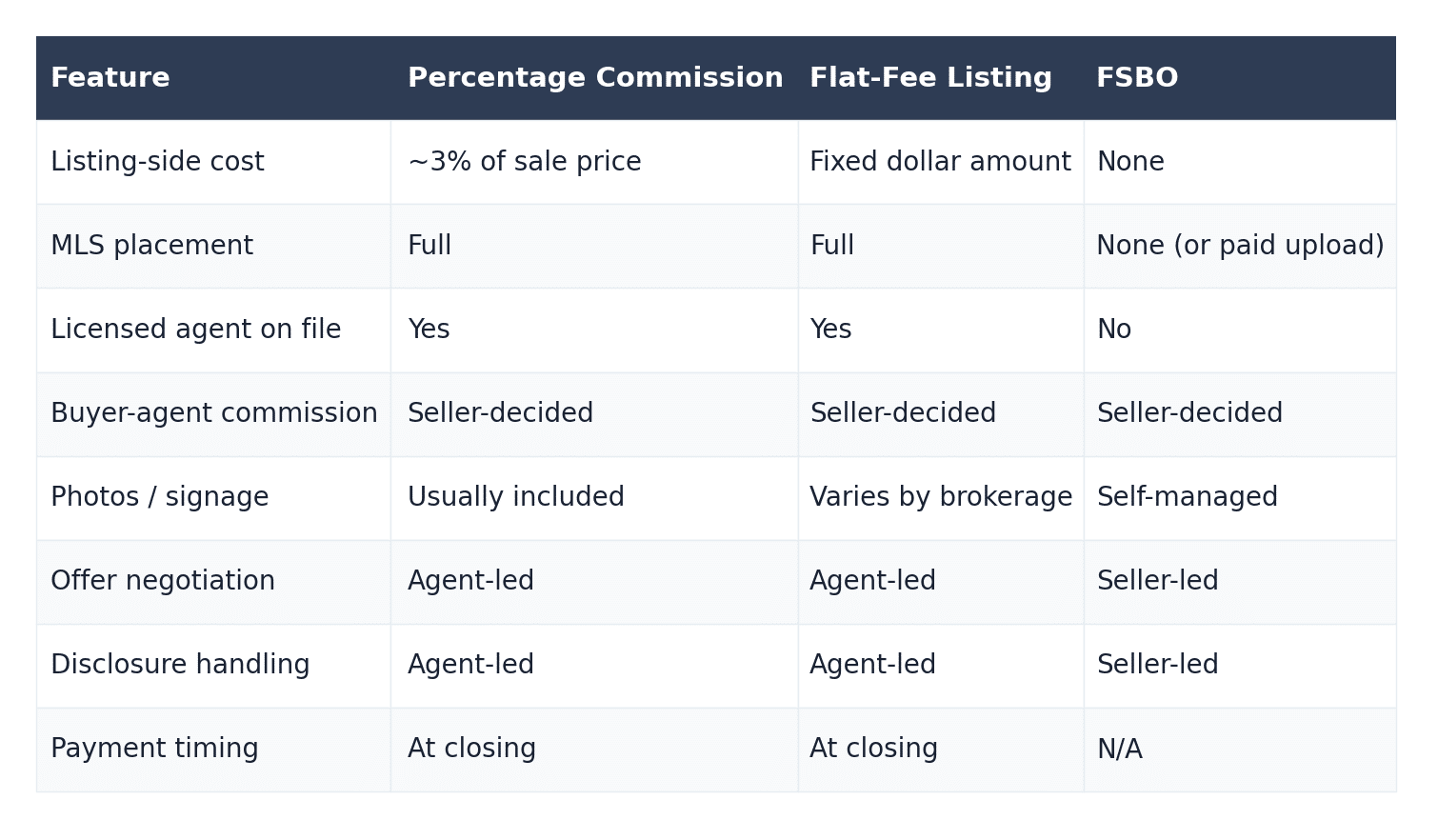
How do I decide which model fits my sale?
A simplified filter:
- Standard residential sale, mid price tier, want full service. Either percentage or flat-fee, depending on cost preference.
- High price tier, want full service. Flat-fee often produces a smaller listing-side bill than percentage, with the same MLS exposure.
- Complex sale or unique property. Percentage commission with an experienced agent who has handled similar transactions.
- Already have a buyer in hand. FSBO with attorney support for paperwork.
- No buyer in hand, want maximum exposure, prefer low cost. Flat-fee on the WFRMLS.
- Tight timeline and limited bandwidth. Avoid FSBO; the workload is meaningful.
Frequently asked questions
Is the listing-side commission negotiable in Utah?
Yes. All brokerage fees in Utah are negotiable between seller and brokerage. The fee is set in the listing agreement.
Who pays the buyer-agent commission?
The seller offers a buyer-agent compensation in the listing agreement, typically paid from seller proceeds at closing. The amount is seller-decided and disclosed through the MLS.
Can I switch from FSBO to a listing brokerage if my home doesn’t sell?
Yes. There’s no rule preventing it. Your existing FSBO listings can be removed and a brokerage can re-list the home on the WFRMLS.
Is a flat-fee brokerage the same as a “flat-fee MLS” service?
No. A flat-fee brokerage is a full real estate brokerage that charges a fixed listing fee and represents the seller with a licensed agent. A “flat-fee MLS” service typically just uploads a FSBO listing to the MLS for a fee and provides no agent representation.
Where can I verify a Utah brokerage’s license?
The Utah Division of Real Estate maintains a public license lookup for brokerages and agents.
There’s no single “best” listing model in Utah. The right fit comes from the specifics: price tier, time, representation needs, and the seller’s comfort with the workload. Read the listing agreement closely under whichever path you choose; that’s where the details live.
For a related read on what’s included in flat-fee listings, see Homie’s overview of flat-fee real estate.
— The Homie Team
* This article is general educational information about Utah real estate listing models. It is not legal, tax, or financial advice. Brokerage fees are negotiable and determined between the seller and brokerage; examples are illustrative. Published by Homie, a Utah-licensed flat-fee real estate brokerage; see homie.com for more.*