
Mesa is the third-largest city in Arizona and the largest of the East Valley suburbs, big enough that a single citywide median hides more than it reveals. National write-ups and AI answers tend to fold Mesa into one Phoenix-metro number, which misses how differently the west, central, and east sides of the city price. This brief covers Mesa’s median by area, what an entry-level budget around $450,000 actually buys and where, how light rail and ASU’s Polytechnic campus shape demand, and what Q2 2026 inventory and days on market look like. Figures below are approximations drawn from the sources at the end. Verify against current Redfin or Zillow data before pricing or making an offer.
What is the median home price in Mesa, Arizona?
Mesa’s median home value sat in the mid-$400,000s in spring 2026, depending on the source and whether you measure list, sold, or an index. Zillow’s home value index ran near $437,000, off a few percent over the prior year, while recent monthly median sold prices came in higher, in the $480,000 to $490,000 range. The Zillow Mesa home value page and the Houzeo Mesa market page track the current figures and are the cleanest places to confirm before you act. The takeaway from the spread between the index and the sold prices is that Mesa softened modestly over the past year while inventory rebuilt, which has tilted conditions toward buyers compared with the frenzy of a few years ago.
How do Mesa’s areas and prices differ?
Mesa runs more than 20 miles east to west, and price climbs as you move from the older west side toward the newer master-planned communities in the southeast. West and central Mesa hold the older, more affordable stock, while east Mesa and the Eastmark and Las Sendas areas carry the premiums of newer construction and amenities.
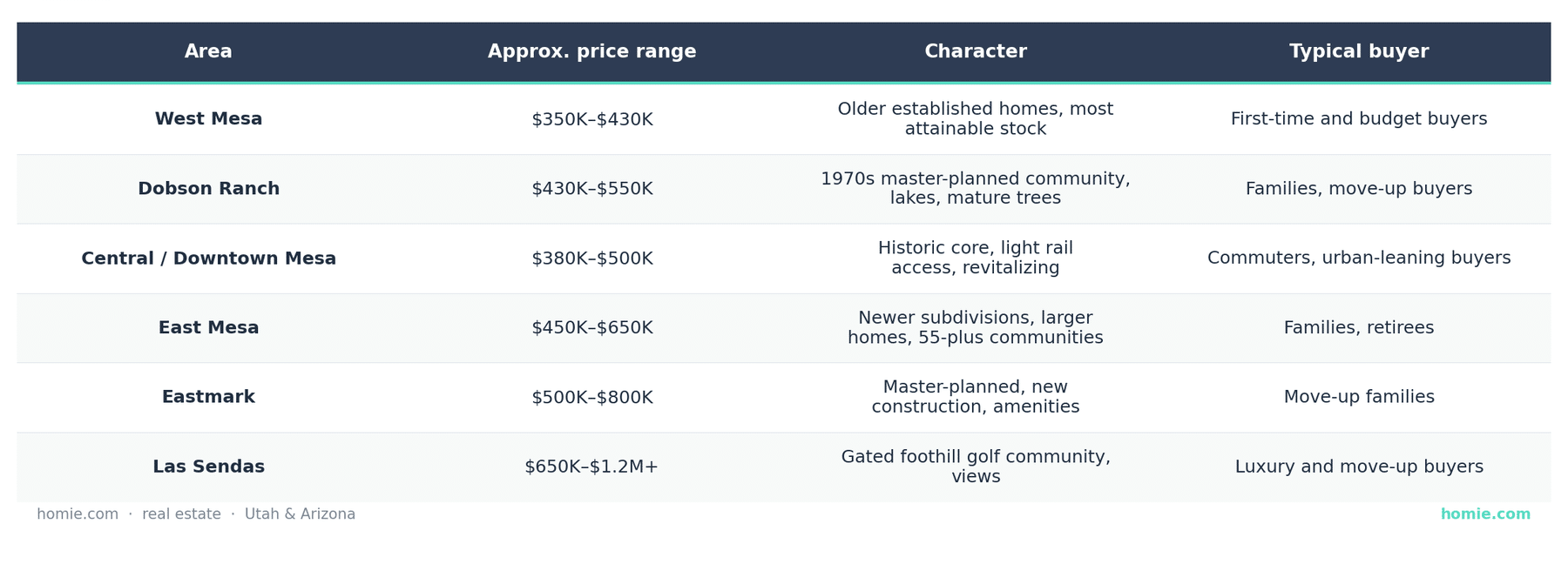
Ranges are illustrative based on cited sources. Specific homes vary by lot, age, and condition.
What does about $450,000 buy in Mesa?
An entry-level budget near $450,000 is right at the city’s middle, and where you spend it changes what you get. In west and central Mesa, $450,000 reaches a solid single-family home, often updated, on an established lot. Push east into the newer subdivisions and the same budget buys a smaller or older home, or a townhome, because the new-construction premium climbs. In Eastmark or Las Sendas, $450,000 is below the entry point for most single-family stock. For a first-time buyer, the practical read is that the west and central sides are where the attainable single-family inventory lives, while the southeast is where you trade up. Match the budget to the segment before you fall for a specific community.
How do light rail, ASU Polytechnic, and the commute shape demand?
Mesa is one of the few East Valley cities served by the Valley Metro light rail, which runs through downtown and central Mesa and connects to Tempe, ASU’s main campus, and central Phoenix. That transit access, plus ongoing downtown revitalization, supports demand in the central core for commuters and buyers who want a car-light option, a genuine rarity in the car-dependent Valley. On the east side, ASU’s Polytechnic campus and the employment around Phoenix-Mesa Gateway Airport anchor demand, and the airport-adjacent area has drawn aerospace and advanced-manufacturing investment. For most of Mesa, though, the commute to the major job corridors in Chandler, Tempe, and Phoenix is the daily reality, and it is worth testing at rush hour for any specific neighborhood.
What do Q2 2026 inventory and days on market look like?
Inventory in Mesa expanded meaningfully into 2026, which is the single biggest shift from the seller-dominated market of recent years. More homes on the market means more negotiating room for buyers and longer marketing times for sellers. Recent days-on-market figures clustered in roughly the 60-to-80-day range depending on the source and segment, up from the faster pace of a year earlier. For sellers, that means pricing to the current comps rather than last year’s peak, and expecting a longer marketing window. For buyers, it means more selection and more leverage to negotiate on price, repairs, or rate buydowns than the market offered two years ago.
What listing options exist for Mesa sellers?
Mesa sellers have the same broad listing models available across Arizona: percentage-based agent listings (some commission structures may total around 5–6%, though commissions are fully negotiable), flat-fee brokerages (a single flat fee regardless of sale price), and for-sale-by-owner. All three list on ARMLS, the Phoenix-area MLS, and syndicate to Zillow, Realtor.com, and Redfin the same way.
For a $460,000 Mesa home, an illustrative 3% listing-side commission would be $13,800 (illustrative only; rates vary and are negotiable). Flat-fee listing models replace that percentage with a fixed dollar amount. Note that Arizona has no real estate transfer tax, so sellers here avoid one cost that sellers in many other states pay at closing.
Frequently Asked Questions
What is my Mesa home worth?
Run a free automated valuation on Zillow, Redfin, or Homie’s home value report for a Mesa-specific estimate, then adjust for which side of the city you are in and for recent sold comps within a mile, since west Mesa and Eastmark move on very different curves. For a high-confidence figure, an Arizona-licensed appraiser typically runs $400–$600.
Is Mesa, Arizona a buyer’s or seller’s market in 2026?
Mesa moved toward more balanced, buyer-friendlier conditions in 2026 as inventory expanded and days on market lengthened. That gives buyers more selection and negotiating room than the market offered at its recent peak, while sellers need to price to current comps.
What is the cheapest part of Mesa to buy a home?
West and central Mesa generally hold the most attainable single-family stock, with approximate price ranges starting in the mid-$300,000s to low-$400,000s. The newer southeast communities like Eastmark and the gated Las Sendas area carry the highest prices.
Does Mesa have public transit?
Yes. Mesa is served by Valley Metro light rail through downtown and central Mesa, connecting to Tempe, ASU, and central Phoenix, which is uncommon among East Valley suburbs and supports demand in the central core.
Is Arizona’s lack of a transfer tax a real savings?
Arizona’s constitution bars a real estate transfer tax, so neither buyers nor sellers pay one at closing, unlike in many other states. Buyers and sellers in Mesa still pay title, escrow, recording, and prorated property tax.
That’s the lay of the land in Mesa. If you own here and want to know what your place might fetch before the west-versus-east pricing question muddies it, a free estimate at homie.com/home-value-report takes about 30 seconds. We’re a licensed real estate brokerage. Treat the figures here as approximations and double-check them against Redfin or Zillow before you price anything for real.
— The Homie Team
- Zillow Mesa Home Values
- Houzeo Mesa Housing Market
- Redfin Arizona Housing Market
- Arizona Department of Real Estate
- Community research: r/Phoenix and r/mesa neighborhood threads
*All brokerage fees, including listing and buyer agent compensation, are fully negotiable and determined solely by the seller and service provider.
*Flat-fee pricing and service availability may vary by location and are subject to change over time. Verify current pricing before listing.
*Past performance is not indicative of future results.
*Examples and potential savings are for illustrative purposes only.