
n the Phoenix metro, “new or used” is a real fork in the road, and the generic national answer misses what actually moves the math here. This is a market of sprawling master-planned communities where builders carry standing inventory, and in 2026 they have leaned on rate buydowns and incentives to move it, which changes the comparison against an established resale home. But the incentive picture is shifting, and it varies sharply by submarket. This guide walks through how each path prices out, what builder incentives look like right now, the timeline and certainty tradeoff, and which fits which buyer. Figures below are illustrative and drawn from the sources at the end. Incentives and rates change frequently and vary by builder and community, so confirm current terms before you commit.
How does each path price out in the Phoenix metro?
They price from different starting points. A new build begins at a builder’s base price, then adds lot premiums and design-center upgrades that can lift the final number well above the sticker, especially in sought-after master-planned communities. A resale home is priced against recent comparable sales, and in a more balanced 2026 market that often means room to negotiate on price, repairs, or closing costs. For much of 2026 the effective-value gap between a comparable new build and a resale narrowed, after running as wide as $50,000 to $100,000 earlier, as resale homes began competing more effectively and new-construction market share fell to its lowest since mid-2022.
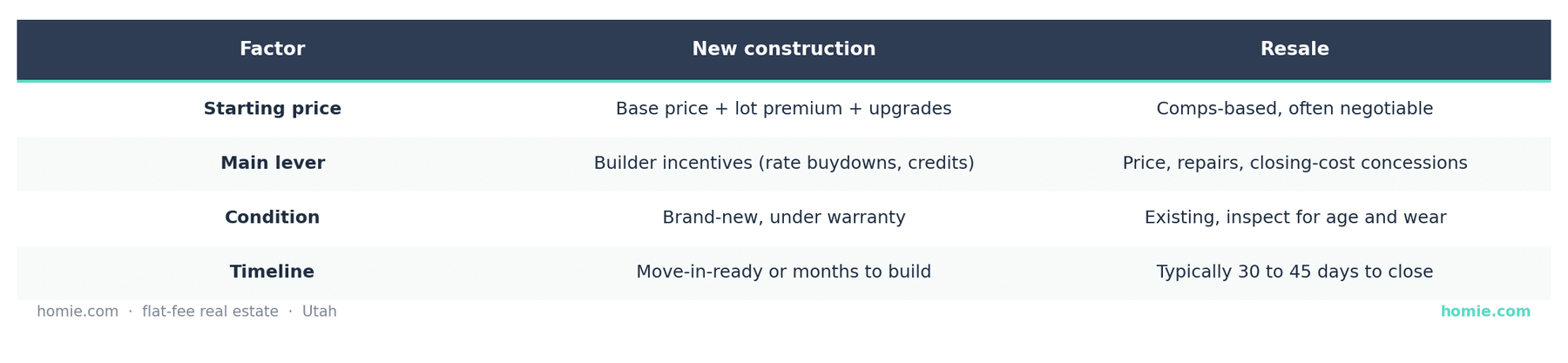
Figures and terms are illustrative and change frequently. Confirm current pricing and incentives with the builder and in the resale comps.
What do builder incentives look like in 2026?
They are still a major force, but a shrinking one, and where they show up matters. Through 2026, builders across the Valley used rate buydowns, closing-cost assistance, and upgrade packages to keep sales moving, though the terms have tightened: advertised buydown rates that reached near 3.99 percent earlier drifted up toward roughly 4.5 percent, and several builders wound down “build from dirt” promotions and long-running design-center credit programs. Geography is the key variable. Incentives remained meaningful in the fast-growing outer suburbs where builders carry the most inventory, including Queen Creek, Buckeye, and San Tan Valley. In the core, higher-demand cities like Scottsdale, Chandler, and Gilbert, aggressive new-construction incentives largely disappeared. So the new-versus-resale math can flip depending on which part of the metro you are shopping.
How do timeline and certainty compare?
This is where resale and new construction trade places. A resale purchase usually closes in about 30 to 45 days, and you see the actual house, the actual neighborhood, and the actual finishes before you commit. A move-in-ready new build can close on a similar timeline, but a to-be-built home runs on the builder’s construction schedule, which can stretch months and shift, a real consideration for a relocating buyer working against a lease or a job start date. The certainty cuts both ways. New construction gives you a brand-new home under warranty with no deferred maintenance, but you may be buying off a rendering and a design center. Resale lets you inspect a standing home for age and wear, but you inherit whatever the prior owner did or did not maintain. A thorough inspection matters in both cases, including on new builds.
Which long-run factors should tip the decision?
Look past the closing to the years after it. New-construction communities are often still building out, which means construction traffic, unfinished amenities, and immature landscaping for a while, plus HOA dues and the lot premium you paid folded into your basis. Resale homes in established neighborhoods come with mature trees, known amenities, and a track record, but also older roofs, HVAC systems, and pools that may need attention sooner. Resale value depends on the specifics either way. A new build in a desirable, filling-in community can appreciate as the area matures, while a well-kept resale in an established, low-inventory neighborhood holds its own. Treat any appreciation as uncertain and weigh warranty, maintenance runway, HOA scope, and commute alongside the price.
Which path fits which buyer?
Match the path to your priorities, not to the model-home sizzle. If you want a brand-new home with warranty coverage, modern finishes, and a builder incentive, and you can wait on a build or shop standing inventory, new construction in an incentive-heavy outer suburb like Queen Creek or Buckeye can pencil out well. If you want an established neighborhood, mature landscaping, negotiating room, and a faster, more certain close, resale is often the stronger play, especially in the core cities where new-build incentives have thinned.
- Want new, under warranty, with incentives: new construction, especially in the outer suburbs still offering rate buydowns.
- Want established, negotiable, and fast to close: resale, especially in Scottsdale, Chandler, and Gilbert.
- On a hard relocation deadline: move-in-ready new build or resale, not a to-be-built home.
- Price-first with time to shop: compare a resale’s negotiated price against a new build’s full incentive package, net of upgrades and lot premium.
Frequently Asked Questions
Is new construction cheaper than resale in the Phoenix metro?
Not usually on the sticker, but incentives can close the gap. A new build starts at a base price and adds lot premiums and upgrades, while resale is priced against comps and is often negotiable in the more balanced 2026 market. Builders in outer suburbs like Queen Creek and Buckeye have offset their prices with rate buydowns and credits, so compare a resale’s negotiated price against a new build’s full incentive package, net of upgrades.
What builder incentives are available in Phoenix in 2026?
Chiefly rate buydowns, closing-cost assistance, and upgrade or design-center credits, though the terms tightened through 2026. Advertised buydown rates that neared 3.99 percent earlier drifted toward about 4.5 percent, and some builders ended “build from dirt” and design-center credit programs. Incentives stayed strongest in high-inventory outer suburbs and largely disappeared in core cities like Scottsdale, Chandler, and Gilbert. Confirm current terms directly with the builder.
How long does it take to buy new construction vs. resale?
A resale typically closes in about 30 to 45 days, and a move-in-ready new build can be similar. A to-be-built home, though, runs on the builder’s construction schedule and can take months, with the timeline subject to change. If you are relocating against a lease or a job start date, that difference is significant, so a standing home, new or resale, is the safer bet on a hard deadline.
Do I need a home inspection on a new-construction home?
Yes. A brand-new home can still have construction defects, and an independent inspection, including at key build phases where allowed, protects you beyond the builder’s own walkthrough. New builds come with warranties, but a warranty is a claims process, not a substitute for catching issues early. Inspect both new and resale homes before closing.
Is it better to buy new or resale in Phoenix right now?
It depends on the submarket and your priorities. In outer suburbs with heavy builder inventory and active incentives, new construction can pencil out well, while in core cities where incentives have thinned, a negotiable resale in an established neighborhood often wins on price and certainty. Weigh warranty and finishes against negotiating room and speed, and run the full net cost each way before deciding.
That’s the honest new-versus-resale read for the Valley. If you’re buying in the Phoenix metro and want a brokerage that will run the real net cost of a new build’s incentive package against a resale’s negotiated price before you tour, talking to a Homie agent is a good place to start. We’re a licensed real estate brokerage. Incentives and rates here are illustrative and change often, so confirm current terms with the builder and in the comps before you commit.
— The Homie Team
- Scott Communities, new construction vs. resale in Phoenix 2026
- The Ravenscroft Group, Phoenix market shift and builder incentives 2026
- The Ravenscroft Group, builder incentives on dirt builds in Phoenix
- Community research: r/azrealestate and r/Phoenix new-build threads
*All brokerage fees, including listing and buyer agent compensation, are fully negotiable and determined solely by the seller and service provider. *Flat-fee pricing and service availability may vary by location and are subject to change over time. Verify current pricing before listing. *Past performance is not indicative of future results. *Examples and potential savings are for illustrative purposes only.