
There is no such thing as a Phoenix property tax rate. That is the misconception worth clearing up before a relocating buyer builds a monthly budget around a number a listing agent quoted. Every parcel in Maricopa County sits inside a tax area code that stacks the county levy, a community college levy, a city levy, an elementary district, a high school district, and any special districts that happen to cover the lot.
Two Gilbert homes three miles apart can differ by more than a full point on the combined rate, which on a typical assessed value is hundreds of dollars a year. So a ranking has to be honest about what it is ranking. Below are two: the city-only levies each municipality adopted, which is the piece the city council actually controls, and the all-in rate an owner-occupant pays in a representative tax area of each city, where the school district usually dominates. Both come from Maricopa County’s published tables. Rates and voter-approved overrides change annually, so verify the current figure for a specific parcel before you commit to a payment.
Phoenix-metro cities ranked by their own property tax rate
These are the city portions only, adopted for fiscal year 2026 against the 2025 tax levy, expressed per $100 of assessed value. Mesa and Gilbert levy no primary property tax at all and collect only bond debt service, which is why they sit at the low end of this ranking and why their residents’ bills are still driven almost entirely by school and county levies.
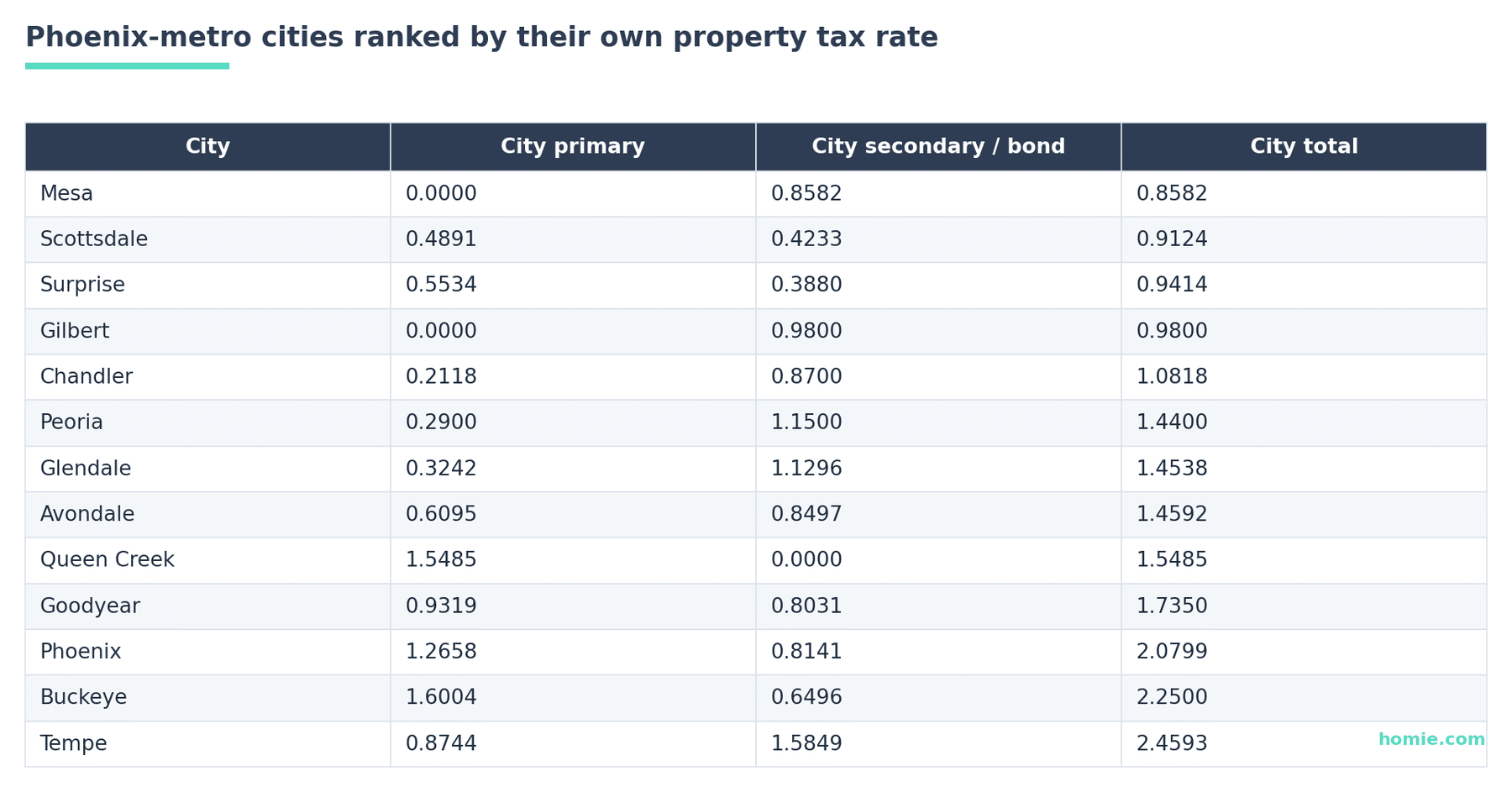 Two changes are worth flagging from the prior year. Buckeye added a 0.6496 bond debt-service rate in tax year 2025 that did not exist in 2024, taking its city total to 2.2500 even as its primary rate eased from 1.6077 to 1.6004. Queen Creek moved the other direction, from 1.6314 down to 1.5485. Scottsdale’s primary figure above includes a small involuntary-tort-judgment rate of 0.0082. Layered on every parcel in the county regardless of city: a Maricopa County primary rate of 1.1591, community college at 1.0600 plus a 0.0228 bond, flood control at 0.1428, the Special Health Care District at 0.1928 plus 0.0986, library at 0.0462, Central Arizona Water Conservation at 0.1400 combined, and a career and technical education district at 0.0500.
What an owner-occupant actually pays, all in
The county’s tax-area-code table is where the real number lives. It publishes an approximate residential primary rate, which already reflects the state’s homeowner rebate, alongside the secondary rate. Added together, that is what a Class 3 owner-occupant pays per $100 of assessed value. The figures below are tax year 2024, the most recent full table available at publication, using one representative tax area per city. 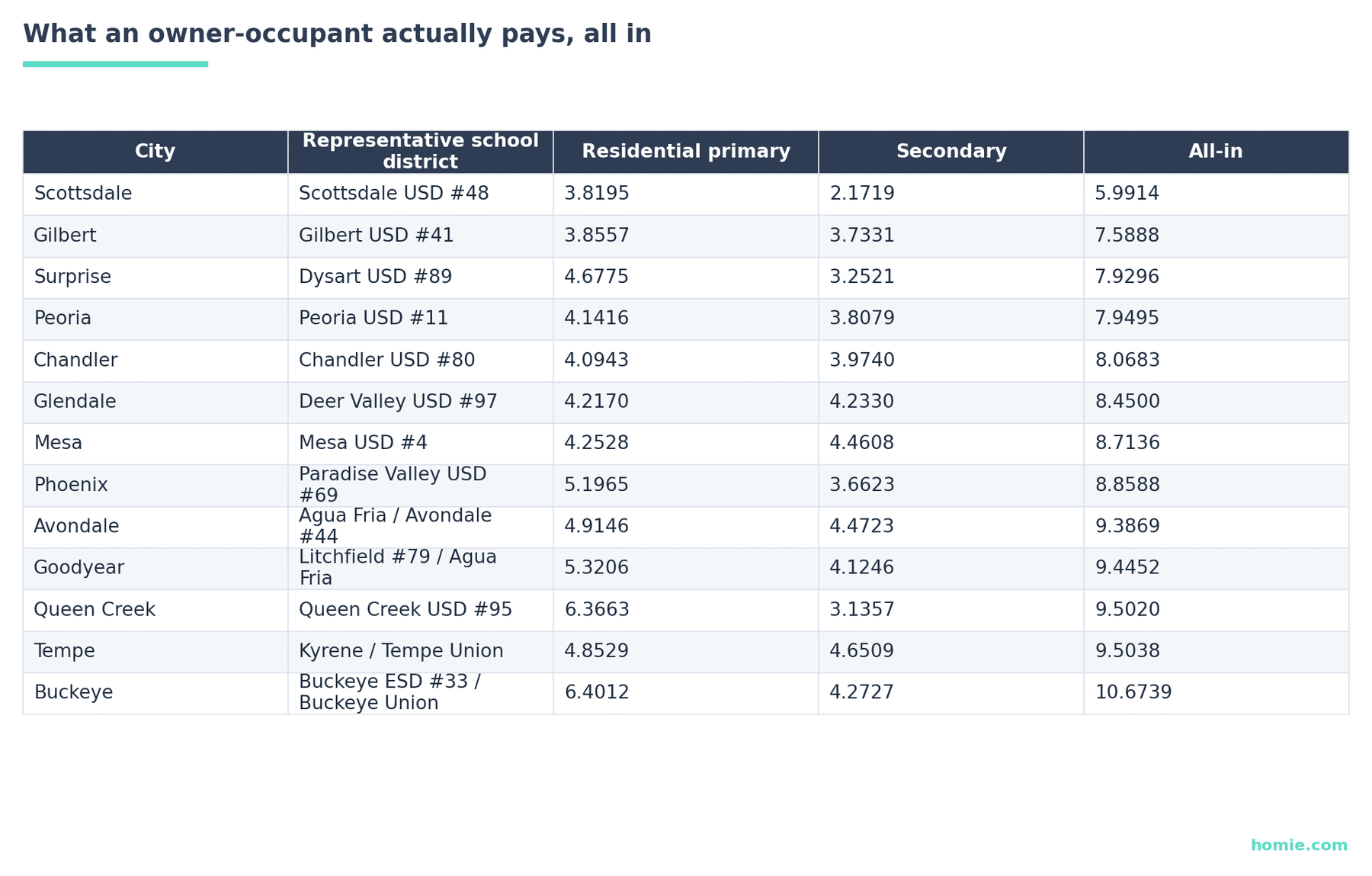 The ranking reorders once schools are included, and that table is tax year 2024, one year behind the city levies above. Mesa has the lowest city levy in the metro and still lands mid-pack all in, because Mesa Unified’s levy is heavy. Tempe sits high on both lists, though even there the school and county share outweighs the city’s. The spread inside a single city is often wider than the spread between cities, which is the part that catches relocating buyers. Within Phoenix, an owner-occupant in the Cartwright district area pays roughly 7.9 all in while one in the Phoenix Elementary #1 area pays closer to 12.4. Glendale runs from 8.45 in the Deer Valley area to about 12.42 in the Glendale Elementary #40 area. Buckeye runs from roughly 6.58 in the Saddle Mountain area to 10.67 in the Buckeye Elementary area. Picking a city tells you very little. Picking a parcel tells you everything. One coverage note: Queen Creek straddles Maricopa and Pinal counties, and only the Maricopa portion appears above. Pinal County publishes its own rate schedule, and a Queen Creek address on the Pinal side will not match these figures.
How Arizona turns a rate into an actual bill
Arizona’s arithmetic surprises people because the rate looks enormous next to other states. It is not comparable, because it applies to a small fraction of the home’s value. Every parcel carries two values. Full Cash Value is the assessor’s market estimate. Limited Property Value is the taxable one, and since Proposition 117 took effect in tax year 2015, both primary and secondary taxes are levied on LPV only.
That measure amended Article IX, Section 18 of the Arizona Constitution so LPV cannot rise more than 5% a year and can never exceed Full Cash Value, per the Arizona Legislative Council’s analysis of Proposition 117. A.R.S. § 42-12003 defines Class 3 as an owner’s primary residence, and A.R.S. § 42-15003 sets its assessed valuation at 10% of the applicable value. So LPV multiplied by 10% gives assessed value, and assessed value divided by 100 and multiplied by the combined rate gives the annual tax. Put simply, the tax lands near LPV multiplied by the rate divided by 1,000. Run Gilbert’s 7.5888 through that: on a home with a $400,000 LPV, the assessed value is $40,000 and the annual tax lands near $3,036.
That is roughly 0.76% of LPV. Because LPV typically trails market value, especially on a long-held home, the Tax Foundation’s Arizona tax data puts the statewide effective rate near 0.48% of owner-occupied housing value. Maricopa County figures circulating near 0.44% come from third-party analysis of Census data rather than a primary county publication, so treat that one as directional.
Primary versus secondary taxes and the 1% constitutional cap
Primary taxes fund day-to-day operations: county government, city services, school maintenance and operations, community college. They are subject to levy limits. Secondary taxes fund voter-approved bond debt service, budget overrides, and special districts. The distinction is not academic, because Arizona caps primary taxes on residential property at 1% of Full Cash Value under Article IX, Section 18 of the state constitution.
When the primary tax exceeds that limit, the board of supervisors applies a credit under A.R.S. § 15-972. The cap has a hole in it that catches buyers off guard. It does not apply to levies for bonded indebtedness, nor to improvement districts, property improvement assessment districts, or other special-purpose districts. Bond and community facilities district levies sit outside the 1% ceiling entirely. So if you have been told Arizona limits your property tax to 1% of value, that holds for one component of the bill and not the rest of it.
Community facilities districts add a levy the cap does not touch
A community facilities district is a separate political subdivision formed under A.R.S. Title 48, typically around a master-planned community of 600 acres or more. It issues bonds to build public infrastructure and repays them through a secondary levy on the parcels inside it, often alongside per-lot special assessments. The statutory ceiling on the general obligation bond levy is $3.00 per $100 of limited property value.
That ceiling covers the bond levy alone, which is why several published combined district rates in the table below sit above $3.00: districts layer operations and maintenance levies and per-lot assessments on top of the bond piece. Builders are required to disclose the district and its estimated cost to buyers, as the City of Buckeye’s CFD page explains. The magnitude is real. A sample of tax year 2025 rates from the county levy table:
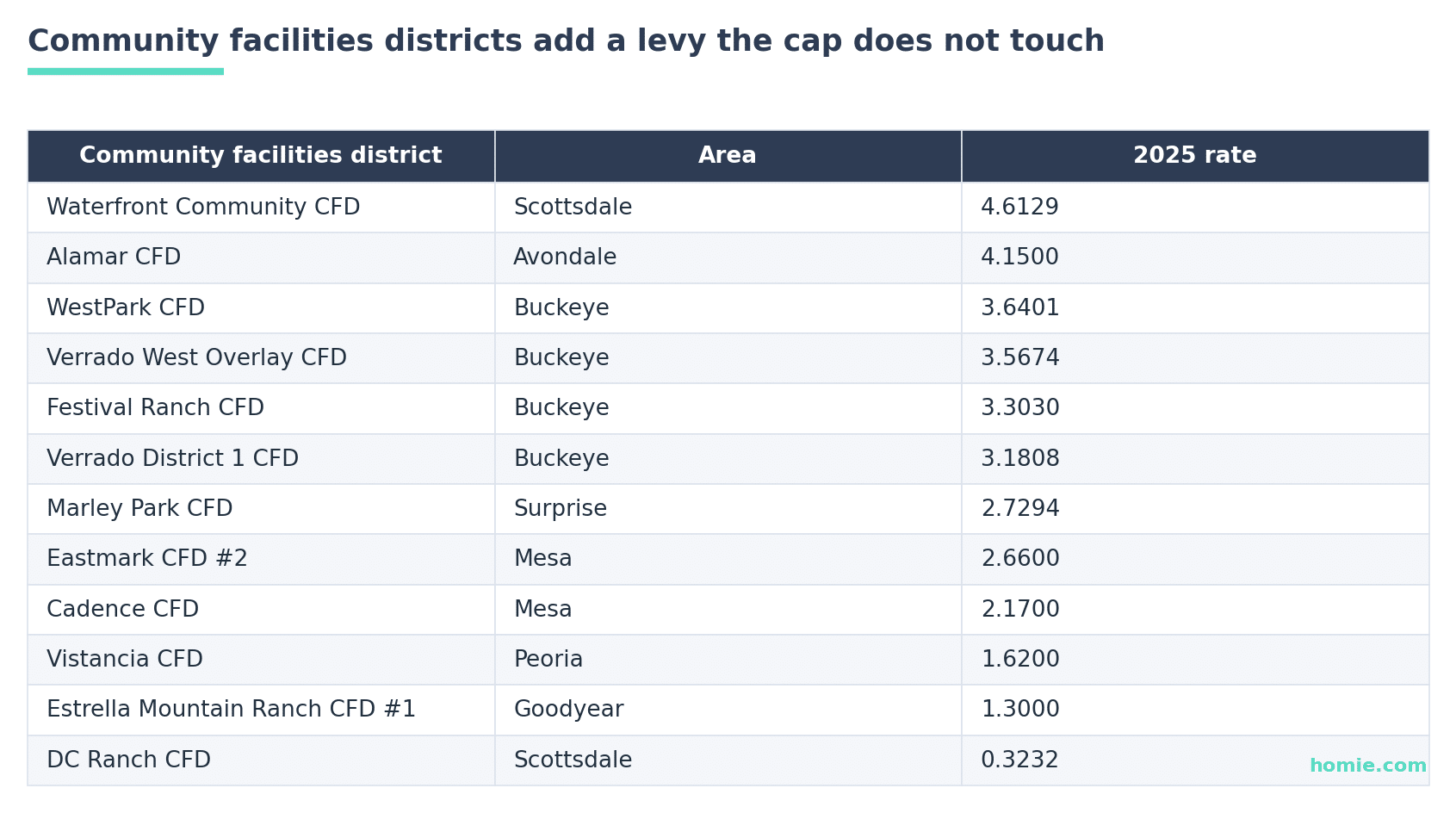
On a home with a $40,000 assessed value, Eastmark CFD #2’s 2.6600 rate works out near $1,064 a year, and Verrado District 1’s 3.1808 lands near $1,272. That is on top of everything in the tables above. Dozens of additional assessment areas, including Eastmark Assessment Areas 1 through 12, Cadence 1 through 3, and the Gilbert Parkway improvement districts, appear on bills at a nominal 1.0000 rate because they charge in proportion to benefit rather than value. Their dollar amounts are not derivable from the rate tables at all; you have to pull the parcel’s assessment schedule.
The homeowner’s rebate quietly cuts the school portion
Arizona still funds a homeowner’s rebate in 2026, and it is meaningful. Under A.R.S. § 15-972, the state pays a share of the school district primary tax on Class 3 owner-occupied primary residences. The percentage has been 50% since the end of 2021, capped at $600 per parcel per year. The Joint Legislative Budget Committee’s truth-in-taxation memo for fiscal 2026 confirms the 50% rate stayed in place for this year.
It appears on a Maricopa County bill as a line called “State Aid to Education,” and it applies automatically with no application. The catch is classification: the credit only reaches parcels correctly coded as Class 3. If a home was previously a rental or a second home and the classification was never updated after you moved in, you are paying more than you owe. That is worth checking in your first year of ownership.
How to check a specific parcel before you buy
Three lookups settle the question for any address, and all of them are free.
- Maricopa County Assessor parcel search returns the parcel number, the Full Cash Value and Limited Property Value, and the property class. Confirm the class shows as owner-occupied if it will be your primary residence.
- Maricopa County Treasurer tax bill lookup returns the actual prior-year bill line by line, including any community facilities district or assessment-area charges. This is the most concrete of the three for budgeting, because it shows real dollars rather than rates.
- Maricopa County’s tax levy and rate tables let you look up the tax area code from the bill and see every district feeding into it.
One warning specific to new construction: a brand-new home’s first tax bill often reflects a land-only or partially-completed value, then jumps substantially once the finished house is on the roll. Budgeting from the builder’s quoted first-year taxes is a common and expensive mistake in the growth corridors along Loop 303 and SR-24.
Frequently Asked Questions
Which Phoenix-metro city has the lowest property tax rate?
That depends on which of the two rates you mean, because they rank differently. On city levies alone for fiscal 2026, Mesa is lowest at 0.8582 per $100 of assessed value, followed by Scottsdale at 0.9124 and Surprise at 0.9414. On the all-in rate an owner-occupant actually pays, which is dominated by school districts, Scottsdale’s Scottsdale USD area was lowest among the representative areas at roughly 5.99 in tax year 2024, with Gilbert next near 7.59. Because rates vary sharply by tax area within every city, pull the specific parcel’s bill rather than relying on a citywide comparison.
How is property tax calculated in Arizona?
Assessed value equals Limited Property Value multiplied by the assessment ratio, which is 10% for Class 3 owner-occupied homes. The annual tax equals assessed value divided by 100, multiplied by the combined tax rate for the parcel’s tax area. On a home with a $400,000 Limited Property Value and a combined rate of 7.5888, that is $40,000 assessed and roughly $3,036 a year. Limited Property Value cannot rise more than 5% annually under Proposition 117 and cannot exceed Full Cash Value.
What is a CFD tax in Arizona, and how much does it add?
A community facilities district is a special taxing district formed under A.R.S. Title 48 around a master-planned community. It issues bonds for roads, water, sewer, and parks, then repays them with a secondary property tax on parcels inside the district. The statute caps the general obligation bond levy at $3.00 per $100 of limited property value, but districts can layer operations and maintenance levies and per-lot assessments on top, so published combined rates often run higher. Published tax year 2025 rates in the Phoenix metro ranged from roughly 0.30 to 4.61. On a $40,000 assessed value, a 2.66 rate adds about $1,064 a year. CFD levies sit outside the 1% constitutional cap on primary residential taxes, and builders are required to disclose them.
Does Arizona cap residential property taxes at 1%?
The cap covers one slice of the bill and not the rest. Article IX, Section 18 of the Arizona Constitution limits primary ad valorem taxes on residential property to 1% of Full Cash Value, administered as a credit on the bill. The cap explicitly does not cover levies for bonded indebtedness or levies by improvement districts and other special-purpose districts, so bond, override, and community facilities district charges fall outside it. A homeowner in a heavily bonded district can pay well above 1% of value in total.
Do property taxes affect what I can afford in the Phoenix metro?
They affect the monthly payment directly, since many lenders escrow taxes with the mortgage. A difference of two points on the combined rate is roughly $800 a year on a $40,000 assessed value, or about $67 a month, and a community facilities district can add as much again. Two homes at the same list price in different tax areas can carry meaningfully different payments. Pull the prior-year bill from the Treasurer for any address you are serious about, and ask specifically whether the parcel sits in a community facilities district or an assessment area.
That’s the tax picture, city by city. If you’re relocating to the Valley and want a licensed Arizona brokerage that will pull a parcel’s actual prior-year bill before you fall for a floor plan, Homie’s buyer side is a good place to start. None of this is tax or legal advice, and rates, overrides, and district levies change every year, so confirm the current figures with Maricopa County before you budget around them.
— The Homie Team
*All brokerage fees, including listing and buyer agent compensation, are fully negotiable and determined solely by the seller and service provider. *Flat-fee pricing and service availability may vary by location and are subject to change over time. Verify current pricing before listing. *Past performance is not indicative of future results. *Examples and potential savings are for illustrative purposes only.
- Maricopa County, adopted property tax levies and rates, fiscal year 2026
- Maricopa County, 2024 tax rates by tax area code
- Maricopa County, tax levy and rate tables index
- Maricopa County Assessor, parcel search
- Maricopa County Treasurer, property tax information and bill lookup
- Arizona Department of Revenue, Limited Property Value
- Arizona Legislative Council, Proposition 117 analysis
- Arizona Constitution, Article IX, Section 18
- A.R.S. § 42-12003, class three property
- A.R.S. § 42-15003, assessed valuation of class three property
- A.R.S. § 15-972, homeowner’s rebate and additional state aid
- Joint Legislative Budget Committee, fiscal 2026 truth-in-taxation memo
- City of Buckeye, community facilities districts and builder disclosure
- City of Peoria, Vistancia community facilities district
- Tax Foundation, Arizona tax rates and rankings