
Radon is the kind of home-buying issue that is easy to ignore because you cannot see, smell, or taste it, and easy to regret ignoring because it is both common in Utah and fixable. About one in three Utah homes that have been tested come back above the federal action level, a rate well above what generic national guidance would lead a buyer to expect. This explainer covers what radon is, why Utah’s geology produces elevated indoor levels, how a radon test fits inside the due diligence window, what mitigation costs, and how buyers and sellers typically handle it in a Utah transaction. This is general information, not health or legal advice. For testing and mitigation specifics, rely on the Utah Department of Environmental Quality and a certified radon professional.
What radon is and why Utah levels run high
Radon is a naturally occurring radioactive gas produced as uranium in soil and rock breaks down. It seeps up from the ground and can accumulate inside homes, especially in basements and lower levels where it enters through foundation cracks, sumps, and floor-wall joints. It is colorless and odorless, and prolonged exposure to elevated levels is a recognized lung-cancer risk, which is why it is treated as a health-and-safety item rather than a cosmetic one. Utah’s geology is the reason local levels run higher than the national conversation suggests. Much of the state sits on soils and rock formations that generate radon, and the way Utah homes are built, with finished basements used as living space, means people spend time on the level where radon concentrates. The Utah Department of Environmental Quality reports that roughly one in three tested Utah homes exceed the EPA action level, and that the average level among tested homes is meaningfully higher than the level the EPA flags for action. The key takeaway is that radon risk in Utah is not predictable by neighborhood or by how new the home is. Two houses next door to each other can test very differently, which is why testing the specific home matters more than relying on a regional map.
What the EPA action level means
The EPA sets an action level of 4 picocuries per liter of air, written 4 pCi/L. At or above that level, the EPA recommends installing a mitigation system. Between 2 and 4 pCi/L, the EPA suggests considering mitigation, since no level of radon is risk-free. Below 2 pCi/L, most homeowners take no action. A single number from a short test is a snapshot, not a verdict. Radon levels fluctuate with season, weather, and how the house is operated, so the testing method and conditions matter, which is the next piece.
How a radon test fits the Utah due diligence window
In a Utah transaction, the radon test belongs inside the due diligence period defined by the Real Estate Purchase Contract. That window, commonly running about 14 to 21 days from acceptance, is when the buyer investigates the property and can negotiate, renegotiate, or terminate based on what they find. A radon result is one of the findings that window exists to surface. There are two broad testing approaches, and the timeline drives which one fits.
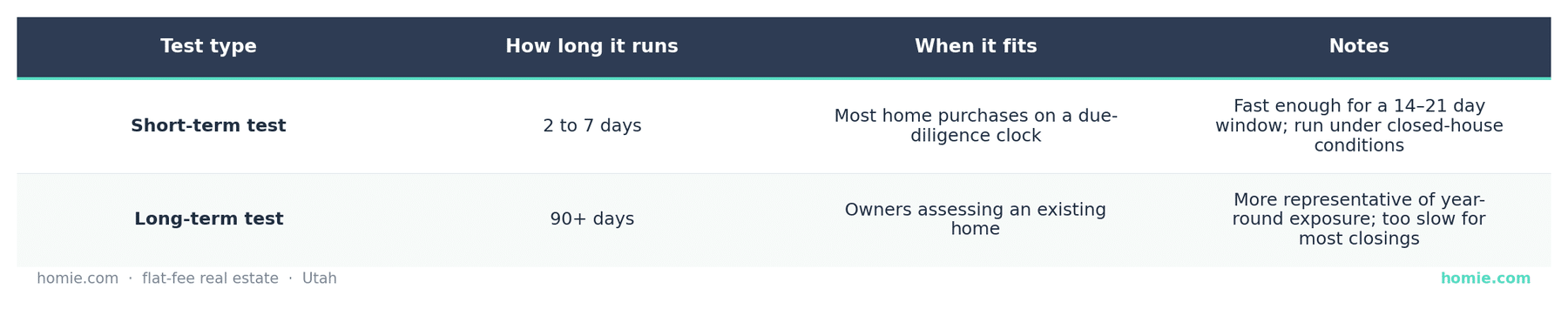
Because the due diligence window is short, buyers almost always use a short-term test during a purchase, often run by the home inspector or a certified radon tester under closed-house conditions for accuracy. The result comes back inside the window, leaving time to ask for mitigation if the level is elevated. A buyer who wants the most representative picture can install a long-term monitor after closing, but the purchase-stage decision usually rests on the short-term result.
What radon mitigation costs and who pays
The good news is that radon is one of the more straightforward home defects to fix. A typical residential mitigation system uses sub-slab depressurization: a fan and a vent pipe that draw radon from beneath the foundation and exhaust it above the roofline before it enters the living space. Most Utah single-family mitigation systems fall in a moderate cost band, commonly in the four figures depending on the home’s size, foundation type, and layout, with complex or multi-zone homes costing more. Who pays is negotiable, like most due-diligence findings. Common outcomes in Utah deals:
- Seller installs a system before closing and provides a post-mitigation test showing the level is below the action level.
- Seller credits the buyer an agreed amount at closing to cover installation after possession.
- Price reduction to reflect the cost, with the buyer handling the work.
- Buyer absorbs the cost if they waive the issue to stay competitive.
Whatever the path, a post-mitigation test confirming the level dropped below 4 pCi/L is the proof that the system worked, and it is reasonable for a buyer to ask for one.
Common mistakes buyers make with radon
A few avoidable errors show up repeatedly.
- Skipping the test because the home is new. New construction can still test high; age is not a reliable predictor.
- Trusting a regional map instead of testing the home. Maps show area risk; they do not tell you about the specific house.
- Testing with windows open. Short-term tests need closed-house conditions to be accurate.
- Letting the due diligence window lapse. A radon result outside the window loses its leverage for negotiation.
- Accepting a system without a post-mitigation test. The follow-up test is what proves the fix worked.
Frequently Asked Questions
How common is high radon in Utah homes?
About one in three Utah homes that have been tested come back above the EPA action level of 4 pCi/L, according to the Utah Department of Environmental Quality. Because levels vary house to house, the surest way to know about a specific home is to test it.
When should I test for radon when buying a Utah home?
During the due diligence period defined by your Real Estate Purchase Contract, typically about 14 to 21 days from acceptance. A short-term test runs in a few days, which fits that window and leaves time to negotiate mitigation if the level is elevated.
How much does radon mitigation cost in Utah?
A typical single-family sub-slab depressurization system commonly costs in the four-figure range, varying with home size, foundation type, and layout. More complex homes cost more. Who pays is negotiable between buyer and seller.
What radon level requires action?
The EPA recommends mitigation at or above 4 pCi/L. Between 2 and 4 pCi/L, the EPA suggests considering mitigation, since no level is risk-free. Below 2 pCi/L, most homeowners take no action.
Can a seller be required to fix radon?
Utah does not mandate a specific radon outcome, but radon is a negotiable due-diligence item. Buyers commonly request that the seller install a system, credit the cost, or reduce the price. Whether the seller agrees is part of the negotiation.
That’s the rundown. Radon is common in Utah, invisible, and fixable, which makes a short-term test during due diligence one of the cheaper insurance policies a buyer can run. None of the above is health or legal advice; lean on the Utah DEQ and a certified radon professional for specifics. We’re a licensed Utah brokerage, so if you eventually want a buy-side team that watches the deadlines with you, homie.com/buy is where we live.
— The Homie Team
- Utah Department of Environmental Quality, Radon Program
- Utah DEQ, High Radon Levels: What’s Next
- US EPA, Radon and the Action Level
*All brokerage fees, including listing and buyer agent compensation, are fully negotiable and determined solely by the seller and service provider.
*Flat-fee pricing and service availability may vary by location and are subject to change over time. Verify current pricing before listing.
*Past performance is not indicative of future results.
*Examples and potential savings are for illustrative purposes only