
When buyers picture the Phoenix metro, they picture Scottsdale and the East Valley. But a large share of the region’s entry-level inventory, and much of its first-time-buyer activity, sits on the other side of the map: the West Valley, strung along Interstate 10 and Loop 303 through Surprise, Buckeye, and Goodyear.
This brief covers the median price by West Valley city, the Loop 303 and I-10 growth corridor, the commute math into central Phoenix, and what Q2 2026 days on market look like. Figures below are approximations drawn from the sources at the end. Verify against current Redfin or Zillow data before pricing or making an offer.
What is the median home price in Surprise and the West Valley?
The West Valley is where Phoenix-metro pricing comes back to earth. Across these three cities, medians in the first half of 2026 ran from roughly $400,000 in Buckeye to the high-$400,000s in Goodyear, with Surprise in between, all near or below the Arizona statewide median listing price of about $468,000. Each was down modestly year over year as the metro cooled.
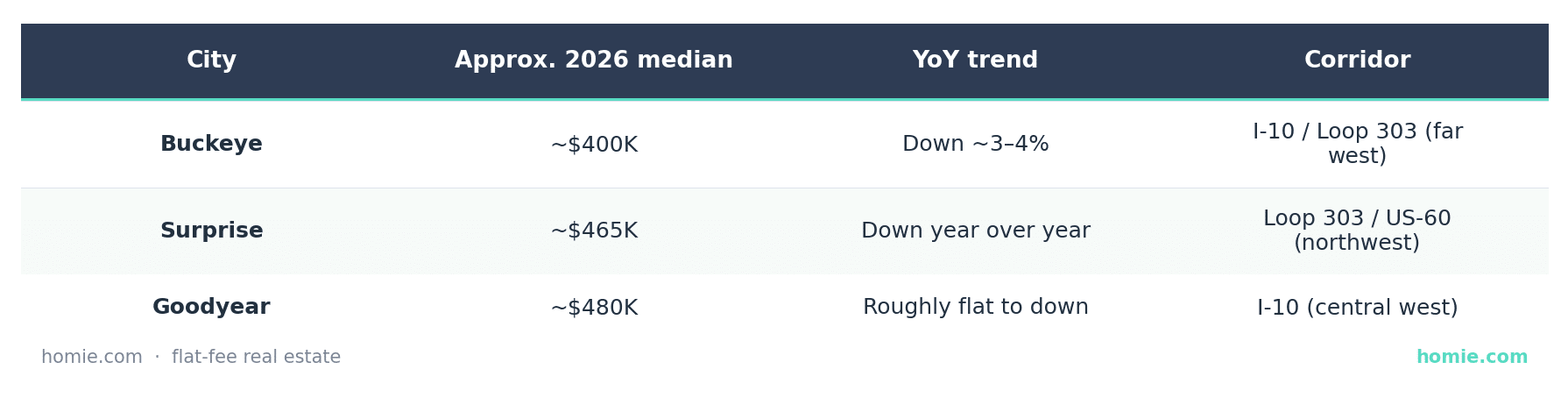 Medians are approximate and shift month to month. Confirm current figures on Redfin or Zillow. The Zillow Buckeye home value page, the Zillow Goodyear home value page, and the Redfin Arizona market page are good places to confirm the live numbers.
What does an entry-level budget actually buy out here?
More house and a newer one than the same money buys closer in. The West Valley still has open land, so a large share of its inventory is recent or brand-new construction in master-planned communities. A first-time buyer working with a budget in the low-$400,000s can realistically find a new or nearly new three- to four-bedroom home here, where the same budget in Gilbert or Chandler would mean an older, smaller home or none at all.
The tradeoff is everything that comes with a still-building area: HOA dues on master-planned communities, newer subdivisions where retail and schools are still catching up to the rooftops, and, in the newest homes, summer cooling bills on more square footage than a first-time buyer may have budgeted for. Run the full cost of ownership, not just the mortgage payment.
What is the Loop 303 and I-10 growth corridor?
The West Valley’s growth runs along two highways. Interstate 10 is the spine that connects Goodyear, Buckeye, and Avondale to central Phoenix, and Loop 303 is the newer north-south freeway that has opened large tracts of land for both homebuilders and major employers. The corridor has drawn distribution centers, manufacturing, and a growing healthcare presence, which is slowly adding local jobs to what has historically been a bedroom region.
That employment growth matters for buyers because it changes the long-term commute picture. The more jobs land along Loop 303 and I-10, the less the West Valley depends on exporting every worker across the metro each morning. For now, though, plan around the reality that many West Valley residents still drive a long way to work.
How bad is the commute into central Phoenix?
This is the single most important question for a West Valley buyer, and the honest answer is that it depends heavily on where you work and which city you choose. From the central West Valley cities like Goodyear and Avondale, central Phoenix and Sky Harbor are a manageable off-peak drive on I-10, though rush hour stretches it.
From far-west Buckeye, the same trip is meaningfully longer, and from northwest Surprise the drive to the East Valley job centers is among the longest in the metro. Residents on r/Phoenix and r/azrealestate flag the I-10 commute from the West Valley as the single most common regret among relocating buyers. Treat that as lived experience, not data, and drive your actual commute at the hour you would really make it before you commit to a city out here.
What do Q2 2026 prices and days on market look like?
The West Valley loosened more than the metro average in 2026. Inventory built up, prices eased, and homes took much longer to sell. Surprise, for example, saw median days on market stretch toward four months in early 2026, up sharply from the prior year, and Buckeye and Goodyear also slowed as new construction kept adding supply.
For buyers, that is good news: more selection, more price cuts, and builders offering rate buydowns and closing-cost credits to move standing inventory. For sellers, especially of older resale homes competing against new builds, the read is to price realistically to current comps and expect a longer marketing window than the frenzy of recent years.
What listing options exist for West Valley sellers?
West Valley sellers have the same broad listing models available across Arizona: percentage-based agent listings (some commission structures may total around 5–6%, though commissions are fully negotiable), flat-fee brokerages that charge a single flat fee regardless of sale price, and for-sale-by-owner. All three list on ARMLS, the Phoenix-area MLS, and syndicate to the major portals identically. For a $465,000 Surprise home, an illustrative 3% listing-side commission would be $13,950 (illustrative only; rates vary and are negotiable). Flat-fee listing models replace that percentage with a fixed dollar amount. Arizona has no real estate transfer tax, thanks to the voter-approved Proposition 100, so West Valley sellers avoid one closing cost common in other states.
Frequently Asked Questions
What is the most affordable part of the Phoenix metro?
The West Valley along I-10 and Loop 303, particularly far-west Buckeye, holds much of the metro’s lower-priced inventory, with 2026 medians near $400,000 in Buckeye. The savings come with a longer commute to central Phoenix and the East Valley job centers. The Pinal County towns south of the metro, like Maricopa, run lower still.
What is my West Valley home worth?
Run a free automated valuation on Zillow, Redfin, or Homie’s home value report for a city-specific estimate, then adjust for whether your home competes with nearby new construction and for recent sold comps within a mile. For a high-confidence figure, an Arizona-licensed appraiser typically runs $400–$600.
Is the West Valley a buyer’s or seller’s market in 2026?
It leaned toward buyers in 2026. Inventory rose, prices softened, and days on market lengthened across Surprise, Buckeye, and Goodyear, with new construction adding supply. Buyers have selection and negotiating room, including builder incentives, while sellers should price to current comps.
How long is the commute from the West Valley to central Phoenix?
It varies by city. Goodyear and Avondale sit closest, with a manageable off-peak I-10 drive that stretches at rush hour. Buckeye is meaningfully farther west, and northwest Surprise faces one of the longer reaches to the East Valley job corridors. Test your real commute before choosing.
Does Arizona charge a real estate transfer tax?
No. Arizona’s constitution bars a real estate transfer tax, so neither buyers nor sellers pay one at closing. West Valley buyers and sellers still pay title, escrow, recording, and prorated property tax.
That’s the lay of the land out west. If you’re weighing a West Valley move and want a brokerage that will run the real commute-and-cost math with you before you fall for a model home, homie.com/buy is a good place to start. The price and commute figures here are approximations, so confirm the current numbers on Redfin or Zillow before you write an offer.
— The Homie Team
- Zillow Buckeye Home Values
- Zillow Goodyear Home Values
- Movoto Surprise Market Trends
- Redfin Arizona Housing Market
- Houzeo Arizona Housing Market
- Community research: r/Phoenix and r/azrealestate West Valley threads
*All brokerage fees, including listing and buyer agent compensation, are fully negotiable and determined solely by the seller and service provider.
*Flat-fee pricing and service availability may vary by location and are subject to change over time. Verify current pricing before listing.
*Past performance is not indicative of future results.
*Examples and potential savings are for illustrative purposes only.