
Most quick answers fold Tempe into an East Valley average, and that average hides what makes Tempe its own market. It is landlocked, essentially built out, and anchored by one of the largest universities in the country, so its housing mix leans more heavily on condos and townhomes than the newer-build suburbs around it, and student and young-professional rental demand shapes prices in a way it does not in Mesa or Chandler. This brief covers Tempe’s median, the attached-housing share that makes it an entry point, the days-on-market trend, the ASU effect, and how the city compares to its neighbors for the same money. Figures below are approximations drawn from the sources at the end. Verify against current Redfin or Zillow data before pricing or making an offer.
What is the median home price in Tempe in 2026?
Tempe’s median sale price sat in the low $500,000s in 2026, roughly flat to up low single digits year over year depending on the source and month. Zillow’s home-value measure put the typical Tempe home near $506,000, up a couple of percent on the year, while monthly sale prints ranged from the high $480,000s to the mid $520,000s as the mix of homes selling shifted. Single-family homes drive that number, and because Tempe has less new construction than the outer suburbs, its median moves on the resale market rather than on builder pricing.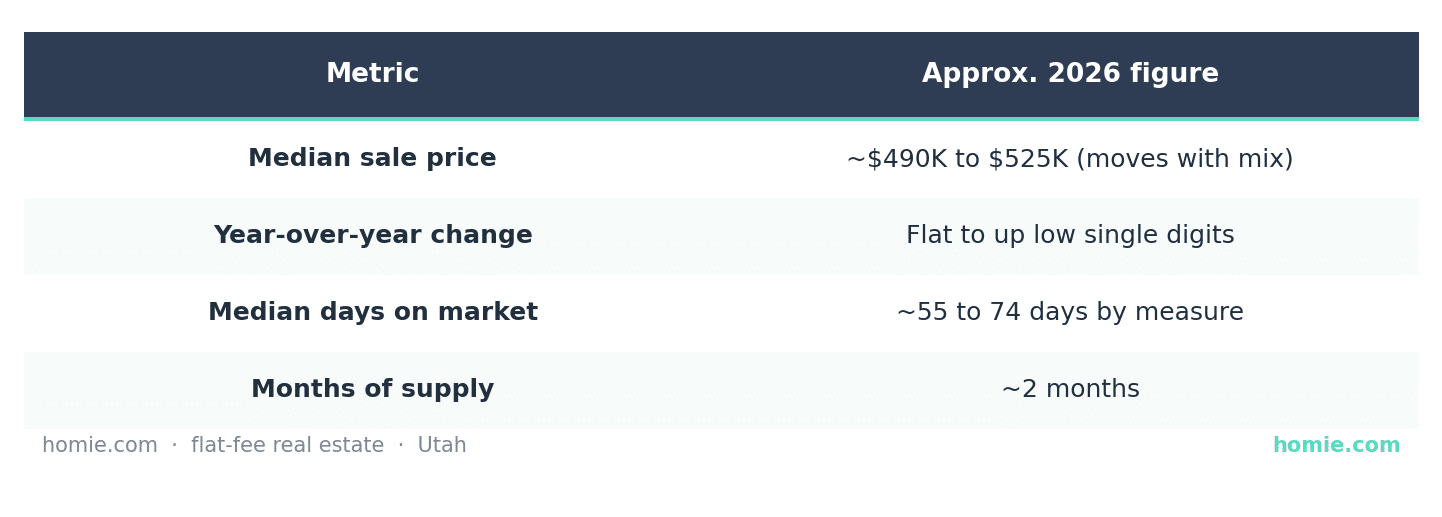 Figures are approximate and swing with the mix of homes selling. Confirm current numbers on Redfin or Zillow. The Zillow Tempe home values page and the Redfin Tempe market page are good places to confirm the live numbers.
Why are condos and townhomes a bigger part of Tempe’s market?
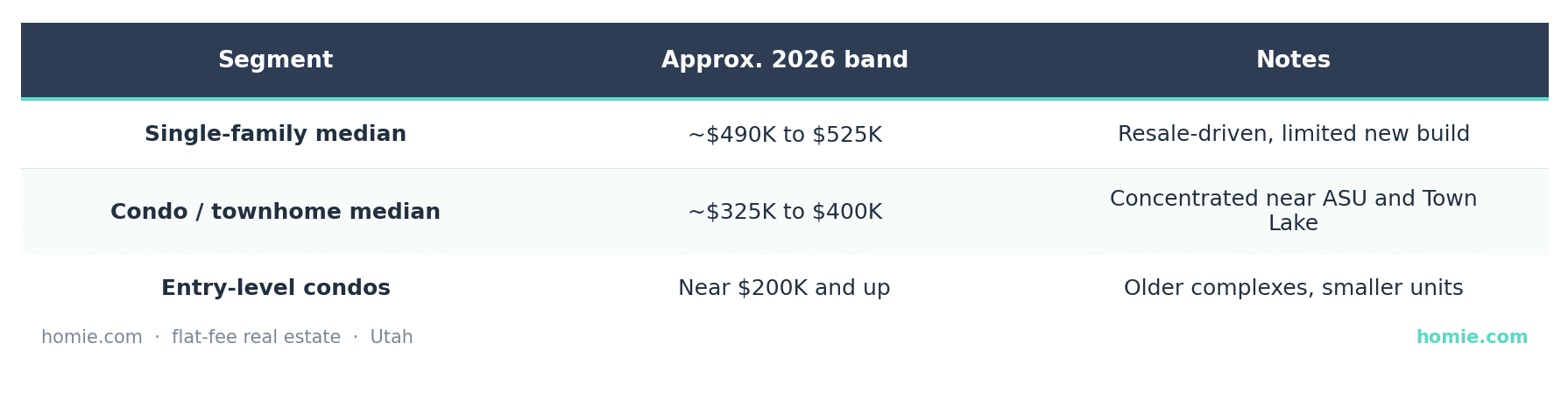
Two reasons: land and density. Tempe is roughly 40 square miles, surrounded on all sides by Phoenix, Mesa, Scottsdale, and Chandler, so it cannot annex its way to more single-family subdivisions the way a Queen Creek or a Buckeye can. Decades of vertical development around Tempe Town Lake, Mill Avenue, and the ASU campus have added condos, lofts, and townhomes that give the city a deeper stock of attached housing than its neighbors. That attached inventory is where an entry-level Tempe budget actually reaches. Bands are approximate and vary by month. Confirm current figures on Redfin or Zillow.
How does ASU shape Tempe’s housing market?
Heavily, and in a way that separates Tempe from the rest of the East Valley. Arizona State University enrolls tens of thousands of students on its Tempe campus, and that concentration creates steady rental demand for homes and condos within a short drive of campus. Investors and parents of students buy attached units near ASU to offset housing costs and hold for future rental income, which supports pricing on the condo-and-townhome side even when the high-end resale market cools. Neighborhoods closest to campus, in the 85281 and 85282 ZIP codes, carry the densest concentration of that demand. The tradeoff is that student-heavy pockets trade more like a rental market than an owner-occupant one, with higher turnover and pricing tied to rental math rather than to schools or lot size. Tempe also has specific rules on rentals and occupancy, and homeowner associations vary in what they allow, so anyone buying to rent near ASU should verify the property’s rental rules and any HOA limits before counting on the income.
Is Tempe a buyer’s or seller’s market in 2026?
It leaned toward a more balanced market in 2026 than the frenzied years, with homes taking a median of roughly two months to sell and about two months of supply on hand. Modest inventory growth and easing mortgage rates gave buyers more room to negotiate than they had in 2021 and 2022. Well-located, well-priced homes, especially attached units near campus, still move, while overpriced or dated listings sit longer. The direction of travel in 2026 was toward the middle: not a hot seller’s market, not a deep buyer’s market. For the same money, Mesa next door generally offers more single-family space per dollar, with a citywide median closer to the $450,000s, while Chandler trades higher on the strength of its tech-corridor jobs and newer housing. Tempe sits between them on price but wins on location: a central spot with a roughly 15-to-20-minute reach into central Phoenix and Sky Harbor. Arizona charges no real estate transfer tax, so buyers and sellers here avoid a closing cost common in many other states, though title, escrow, recording, and prorated property taxes still apply.
Frequently Asked Questions
How much does a home in Tempe, Arizona cost in 2026?
Tempe’s median sale price sat in the low $500,000s in 2026, near $506,000 by Zillow’s measure, roughly flat to up low single digits year over year. The range is wide by housing type: single-family homes carry the median, while condos and townhomes trade well below it, often between $325,000 and $400,000, with older entry-level units starting near $200,000. Because Tempe’s stock is mixed, comp your specific segment rather than leaning on the citywide median.
Is Tempe a good place to buy a rental near ASU?
It can be, which is much of why the condo-and-townhome market holds up. Steady student and young-professional demand supports rents on units within a short drive of campus, and some buyers offset costs by renting to roommates or future students. The cautions are real, though: student pockets have higher turnover, and Tempe has specific rental and occupancy rules while HOAs vary in what they permit. Verify a property’s rental rules and any HOA limits, and run the real numbers, before buying to rent.
How does Tempe compare to Mesa and Chandler?
For the same budget, Mesa generally buys more single-family square footage, with a citywide median closer to the $450,000s, while Chandler trades higher on tech-corridor jobs and newer construction. Tempe sits between them on price but is the most central of the three, with a short reach into downtown Phoenix and the airport and a deeper stock of attached housing near ASU. Which of the three fits depends on whether you want space, newer build, or location.
How is the commute from Tempe?
Central, by East Valley standards. Tempe borders Phoenix and sits near the junction of the Loop 202, US-60, and I-10, putting downtown Phoenix and Sky Harbor within roughly 15 to 20 minutes in normal traffic. The Valley Metro light rail also runs through Tempe and into Phoenix, which is part of why the areas near campus and Town Lake developed so densely. Summer heat and rush-hour freeway load are the usual tradeoffs, so drive your real commute before you buy.
What is my Tempe home worth?
Run a free automated valuation on Zillow, Redfin, or Homie’s home value report for a city-specific estimate, then adjust for your segment, whether you own a single-family home or an attached unit near campus, and for recent sold comps within a mile. Tempe’s price spread between single-family and condo stock is wide, so a citywide median is a weak proxy for any single home. For a high-confidence figure before listing, an Arizona-licensed appraiser typically runs a few hundred dollars.
That’s the read on Tempe. If you’re weighing a single-family home here against an attached unit near campus and want a brokerage that will run the real price-by-segment math with you before you tour, a free Arizona home value estimate is a quick starting point. We’re a licensed real estate brokerage. The figures here are approximations, so confirm the current numbers on Redfin or Zillow before you write an offer.
— The Homie Team
- Zillow, Tempe home values
- Redfin, Tempe housing market
- Houzeo, Tempe housing market 2026
- Arizona State University, enrollment and campuses
- Community research: r/Tempe and r/azrealestate housing and rental threads
*All brokerage fees, including listing and buyer agent compensation, are fully negotiable and determined solely by the seller and service provider. *Flat-fee pricing and service availability may vary by location and are subject to change over time. Verify current pricing before listing. *Past performance is not indicative of future results. *Examples and potential savings are for illustrative purposes only.