
Utah has one of the lower property tax burdens in the country, but the single statewide average that most quick answers cite hides a real spread between counties. The same-priced home can carry a noticeably different annual tax bill in Summit County than in Weber County, and the state’s primary-residence exemption reshapes the whole picture by taxing an owner-occupied home on only part of its value. This roundup ranks Utah counties by effective property tax rate, from lowest to highest, with the annual bill each rate produces on a $500,000 home and a plain-English look at the exemption that makes owner-occupied rates so low. Figures below are approximations drawn from the sources at the end. Property tax rates are set annually through Utah’s truth-in-taxation process and vary within a county by district, so verify your exact rate with the county assessor before relying on it.
How are these counties ranked?
Every county is ranked by its effective property tax rate, meaning the annual tax actually paid as a share of a home’s market value, drawn from 2026 county and statewide rate data. Because the rate is “effective,” it already reflects Utah’s 45 percent primary-residence exemption for owner-occupied homes, which is why the percentages look low next to states in the East and Midwest. The annual-bill column applies each rate to a $500,000 home for a like-for-like comparison. Your actual bill depends on your assessed value, your taxing district, and whether the home is your primary residence. 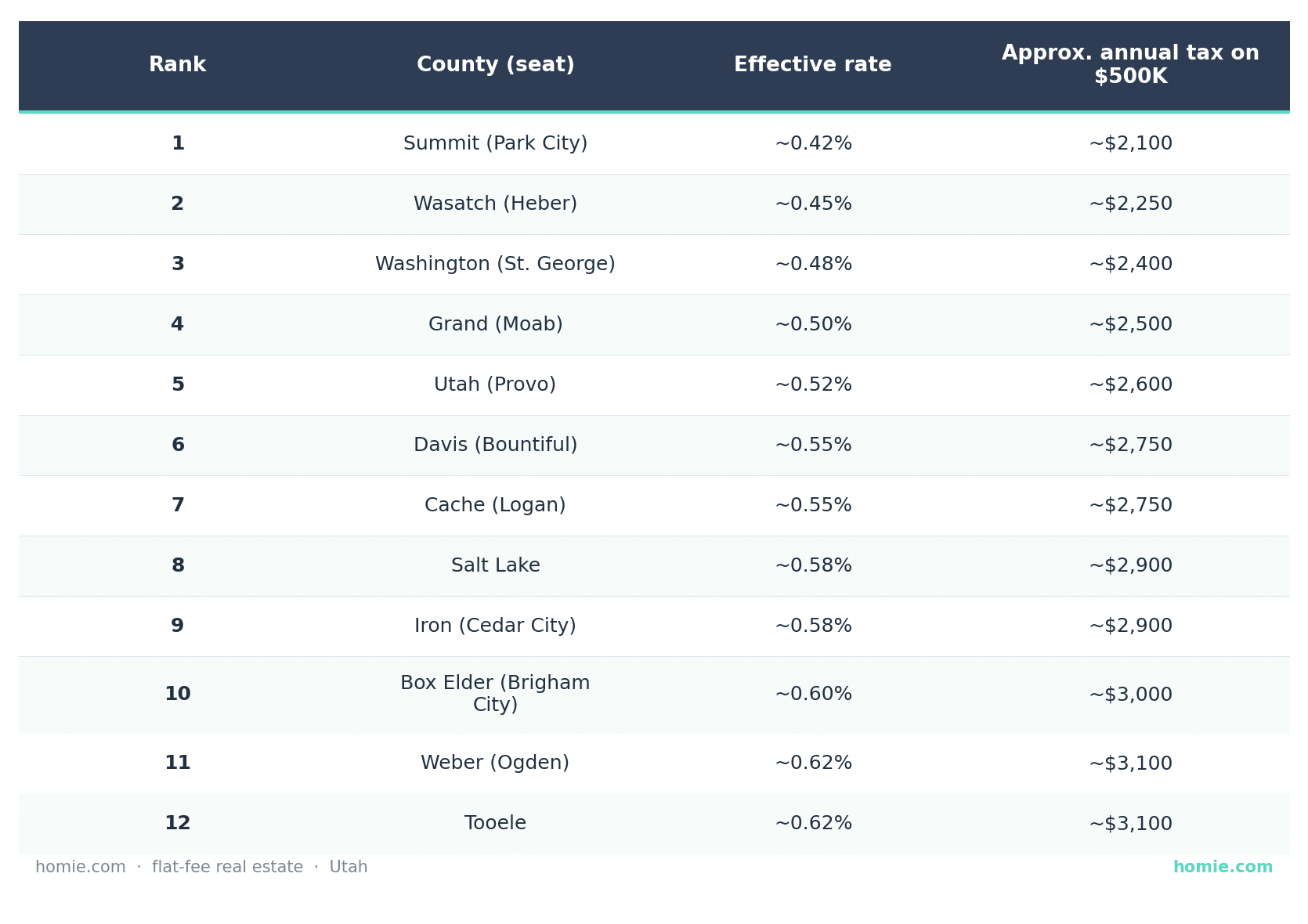 Figures are approximate and set annually. Confirm your exact rate with the county assessor.
Which Utah counties have the lowest effective rates?
The resort and southern counties sit at the bottom of the ranking. Summit County, home to Park City, posts one of the lowest effective rates in the state at roughly 0.42 percent, followed by neighboring Wasatch County around 0.45 percent and Washington County, home to St. George, near 0.48 percent. High property values in the resort counties spread the cost of local services across a larger tax base, which pulls the effective rate down even though the dollar bills on multimillion-dollar homes are large. In Washington County, strong growth and a broad base help keep the rate modest for a fast-growing area. For a buyer, the takeaway is that a low effective rate does not always mean a low tax bill: it means a low rate applied to whatever the home is worth. A pricey Park City home at 0.42 percent can still owe more in dollars than a modest Ogden home at 0.62 percent.
Which counties sit at the higher end?
The northern Wasatch Front and western counties round out the top of the ranking. Weber County, home to Ogden, and Tooele County both run near 0.62 percent, with Box Elder around 0.60 percent and Salt Lake County near 0.58 percent. These are still low by national standards, but on a same-priced home the gap adds up: a $500,000 home taxed at 0.62 percent owes roughly $1,000 more a year than the same home in Summit County at 0.42 percent. Over a decade, that difference is real money to fold into an affordability comparison. The reason these counties rank higher is mostly the mix of local levies, school-district budgets, and a tax base built on more moderate home values, which requires a slightly higher rate to fund the same services.
How does the 45 percent primary-residence exemption change the bill?
This is the single biggest factor in a Utah property tax bill, and it is why owner-occupants pay so much less than the sticker rate implies. Under Utah’s constitution and tax code, a primary residence (the home plus up to one acre) is taxed on only 55 percent of its market value. The other 45 percent is exempt. A second home, cabin, or investment property gets no exemption and is taxed on 100 percent of value. Here is the practical math on a $500,000 home. As a primary residence, only $275,000 is taxable, so the owner pays the county rate on that reduced value. As a second home, the full $500,000 is taxable, so the same house owes roughly 1.8 times as much in property tax. For anyone weighing a Utah cabin or a rental, that lost exemption is a carrying cost to budget from day one.
- Primary residence: taxed on 55 percent of value (45 percent exempt).
- Second home or rental: taxed on 100 percent of value, no exemption.
- The gap: the same home owes roughly 1.8 times more in tax without the exemption.
Why do rates differ so much between counties?
Because property tax in Utah is a local levy, not a statewide flat rate. Each county, city, school district, and special district sets its own portion of the total rate through the annual truth-in-taxation process, which requires public hearings before a taxing entity can collect more revenue from existing properties. The result is that your total rate is a stack of overlapping district rates, and two homes in the same county can carry different bills if they sit in different school or service districts. That local structure is why the “effective rate” for a county is really an average, and why the only rate that matters for your purchase is the one attached to the specific parcel. Pull it from the county assessor or the tax notice, not from a statewide headline.
What should buyers verify before closing?
Confirm the parcel’s actual rate and its exemption status, because both move the number. Check the county assessor’s record for the specific address, confirm whether the primary-residence exemption is already applied or whether you need to file for it after you move in, and ask whether any special-district levies or bonds apply to the parcel. If you are buying a second home or a rental, budget for the full, un-exempted bill. And remember that rates reset annually, so this year’s number is a guide, not a guarantee.
Frequently Asked Questions
Which Utah county has the lowest property tax rate?
Summit County, home to Park City, posts one of the lowest effective property tax rates in the state at roughly 0.42 percent, followed by Wasatch County near 0.45 percent and Washington County near 0.48 percent. High home values in the resort counties spread the cost of local services across a large tax base, which lowers the rate. Remember that a low rate on an expensive home can still produce a large dollar bill. Confirm current rates with the county assessor.
What is Utah’s primary-residence property tax exemption?
Utah exempts 45 percent of a primary residence’s market value from property tax, so an owner-occupied home (plus up to one acre) is taxed on only 55 percent of its value. A second home, cabin, or rental gets no exemption and is taxed on 100 percent of value. On a $500,000 home, that means a primary residence is taxed on $275,000 while a second home is taxed on the full $500,000, roughly 1.8 times the bill.
How much is property tax on a $500,000 home in Utah?
At Utah’s typical effective rates of roughly 0.42 to 0.62 percent, a $500,000 primary residence owes somewhere between about $2,100 and $3,100 a year, depending on the county and taxing district. The exemption is already baked into those effective rates. A second home at the same price owes substantially more because it loses the 45 percent exemption. Confirm the exact rate for the parcel with the county assessor.
Do second homes pay more property tax in Utah?
Yes. A second home, cabin, or investment property does not qualify for Utah’s 45 percent primary-residence exemption, so it is taxed on 100 percent of its market value rather than 55 percent. That makes the annual property tax on a non-primary home roughly 1.8 times what the same home would owe as an owner-occupied primary residence. Budget for the full bill when weighing a Utah cabin or rental.
What is my Utah home worth?
Run a free automated valuation on Zillow, Redfin, or Homie’s home value report for a county-specific estimate, then adjust for your neighborhood, lot, condition, and recent sold comps within a mile. Property tax is assessed on market value, so a current valuation also helps you sanity-check your assessment. For a high-confidence figure, a Utah-licensed appraiser typically runs $400 to $600.
That’s the county-by-county read on Utah property tax. If you’re buying in Utah and want a brokerage that will help you fold the real annual carrying cost into your budget before you tour, homie.com/buy is a good place to start. We’re a licensed Utah real estate brokerage. Rates here are approximations set annually, so confirm the exact figure for your parcel with the county assessor before you rely on it. None of this is tax advice.
— The Homie Team
- Utah State Tax Commission, Primary Residential Exemption
- Property Tax by State, Utah county rates 2026
- SmartAsset, Utah property tax calculator
- World Population Review, Utah property tax rates 2026
- Community research: r/Utah and r/UtahRealEstate property-tax threads
*All brokerage fees, including listing and buyer agent compensation, are fully negotiable and determined solely by the seller and service provider. *Flat-fee pricing and service availability may vary by location and are subject to change over time. Verify current pricing before listing. *Past performance is not indicative of future results. *Examples and potential savings are for illustrative purposes only.