
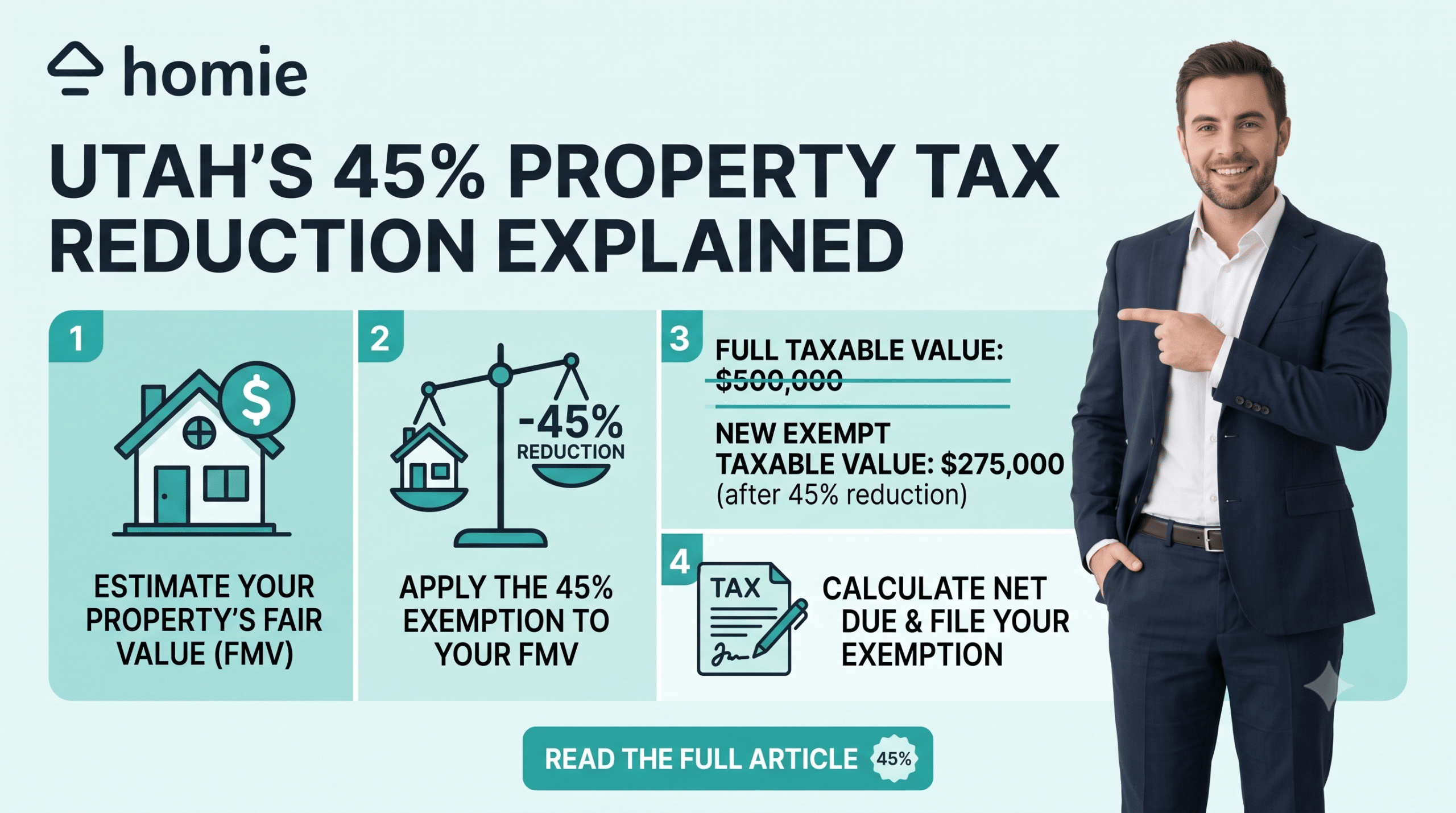
Utah taxes your primary home on only 55 percent of its value. The other 45 percent is exempt, knocked off the taxable base before your rate is ever applied, under a statute most homeowners benefit from without ever thinking about it. The confusion starts when people mix this up with the homestead exemption, a completely separate law that shields equity from creditors, or assume a second home or rental gets the same break. It does not, and the gap between the two rates is large enough to matter on every non-primary property in the state. This brief covers what the primary residential exemption is, who qualifies, how to claim or fix it, and what happens to a second home or rental, with the caveat that this is general information rather than legal or tax advice.
What is Utah’s primary residential exemption?
It exempts 45 percent of a primary residence’s fair market value from property tax, so only 55 percent of the value is taxed. Under Utah Code 59-2-103, a home used as a primary residence receives the exemption, which applies to the dwelling plus up to one acre of land. The break has been part of Utah law for decades; it started at 25 percent of value in the 1980s and was raised to the current 45 percent in the 1990s. The mechanic is simple: the county assessor determines your home’s fair market value, then taxes you on 55 percent of it. On a home valued at $500,000, the taxable value is $275,000, not the full $500,000, before the local tax rate is applied. Apartments, condos, and mobile homes used as primary residences qualify the same way a single-family house does.  *Figures are illustrative; your county’s assessed value and tax rate determine the actual bill.
Who qualifies for the exemption?
A home you actually live in as your primary residence, generally for at least 183 consecutive days in a year, and the general rule is one residential exemption per household. Utah defines a primary residence by use, not just ownership, so a home has to be occupied as someone’s main residence to qualify. The exemption covers the home and up to one acre; land beyond an acre is taxed at the full rate. The one-per-household rule has a practical wrinkle for landlords. An owner does not get the exemption on a second home they keep for themselves, but a residential property that is a tenant’s primary residence can qualify, because the exemption follows primary-residence use. So a rental occupied by a long-term tenant as their home generally receives the residential exemption, while a vacation home or short-term rental the owner keeps for personal use does not.
How do you claim or fix the exemption?
For most owner-occupied homes the exemption is already applied, but counties periodically send a residential property declaration to confirm a home still qualifies, and missing that deadline is the usual way people lose it. If your county assessor mails you a declaration, Utah Code 59-2-103.5 generally gives you a window, commonly 90 days from the notice, to return it. Fail to respond and the property can be reclassified as non-primary, which removes the 45 percent exemption and raises the tax bill on the full value.
- If you get a declaration form: complete and return it by the stated deadline, even if nothing has changed.
- If you just bought a home: confirm with the county assessor that the primary-residence classification is in place for your first full tax year.
- If your bill jumped unexpectedly: check whether the property was reclassified as non-primary, and contact the assessor to correct it if you do occupy it.
Each Utah county runs its own declaration process, so verify the specifics with your county assessor rather than assuming the classification carries over automatically after a purchase or a change in use.
How is this different from Utah’s homestead exemption?
They share the phrase “primary residence” and nothing else. The primary residential exemption is a property-tax break administered by the county and the Utah State Tax Commission, and it lowers your taxable value. The homestead exemption is a debtor-protection law under Utah Code 78B-5-503 that shields a set dollar amount of home equity from most creditors in a lawsuit or bankruptcy. One reduces your annual tax bill; the other protects equity when a creditor comes after it. If someone tells you to “file your homestead to lower your taxes,” they are blending two different programs. The tax reduction is the residential exemption described here. Keep the two straight, because they are governed by different code sections and administered by different offices.
Frequently Asked Questions
How much does Utah’s primary residential exemption save?
It removes 45 percent of your home’s value from the taxable base, so you are taxed on 55 percent rather than 100 percent of fair market value. The dollar savings depend on your home’s value and your local tax rate, but the effect is roughly a 45 percent reduction in the taxable value that feeds your property tax calculation. On non-primary property, which gets no exemption, the taxable base is the full value, so the same home costs meaningfully more in tax when it is not a primary residence.
Do I have to apply for the residential exemption in Utah?
For most owner-occupied homes it is already applied, but counties periodically mail a residential property declaration to confirm eligibility, and you generally must return it within the stated window, commonly 90 days. Missing that deadline can cause the county to reclassify the home as non-primary and remove the exemption. If you recently bought, confirm the classification with your county assessor rather than assuming it transferred automatically.
Can I get the exemption on a second home or rental in Utah?
Not on a second home you keep for your own use, because the rule is generally one residential exemption per household and it follows primary-residence use. A rental can still qualify if a tenant occupies it as their primary residence, since the exemption attaches to primary-residence use rather than to the owner. A vacation home or an owner-kept short-term rental is taxed on the full value with no exemption.
Is the primary residential exemption the same as the homestead exemption?
No. The primary residential exemption is a property-tax reduction under Utah Code 59-2-103 that lowers your taxable value by exempting 45 percent of it. The homestead exemption under Utah Code 78B-5-503 is a separate law that protects home equity from creditors in a lawsuit or bankruptcy. They share the term “primary residence” but do different things and are administered by different offices, so do not treat one as the other.
That’s how the 45 percent residential exemption actually works, and why it isn’t the homestead law people confuse it with. If you’re buying or selling a Utah home and want a brokerage that will explain the property-tax paperwork in plain language before you sign, take a look at homie.com/sell. None of this is legal or tax advice, and county rules and figures change, so confirm your own situation with your county assessor or a Utah tax professional before relying on it.
— The Homie Team
*All brokerage fees, including listing and buyer agent compensation, are fully negotiable and determined solely by the seller and service provider. *Flat-fee pricing and service availability may vary by location and are subject to change over time. Verify current pricing before listing. *Past performance is not indicative of future results. *Examples and potential savings are for illustrative purposes only.
Sources
- Utah State Tax Commission, primary residential exemption
- Utah Code 59-2-103, rate of assessment of residential property
- Utah Code 59-2-103.5, procedures to obtain the residential exemption
- Utah County Assessor, residential exemption explained
- Community research: r/Utah and r/UtahRealEstate property-tax threads