
In 2026, the Wasatch Front did not move as one market. Salt Lake County pushed to a record median while Davis, Utah, and Tooele counties dipped slightly, and individual cities ranged from high-single-digit gains to flat or falling. This ranking sorts the front from fastest-rising to cooling, with an approximate median and year-over-year change for each. One caveat up front: Utah is a non-disclosure state, so single-city medians vary by source and month. The cleanest apples-to-apples year-over-year data is county-level, so the county table below is the anchor, and the city figures that follow are approximate reference points, not precise readings.
Which counties gained and which cooled in 2026?
Salt Lake County led, and the outlying counties slipped. Salt Lake County single-family homes hit a record median near $645,000, up roughly 4.9 percent year over year through mid-2026, per Salt Lake Board of Realtors data. Weber County rose about 3.1 percent, while Utah, Davis, and Tooele counties each dipped one to two percent as new-construction and condo supply pulled entry prices down. 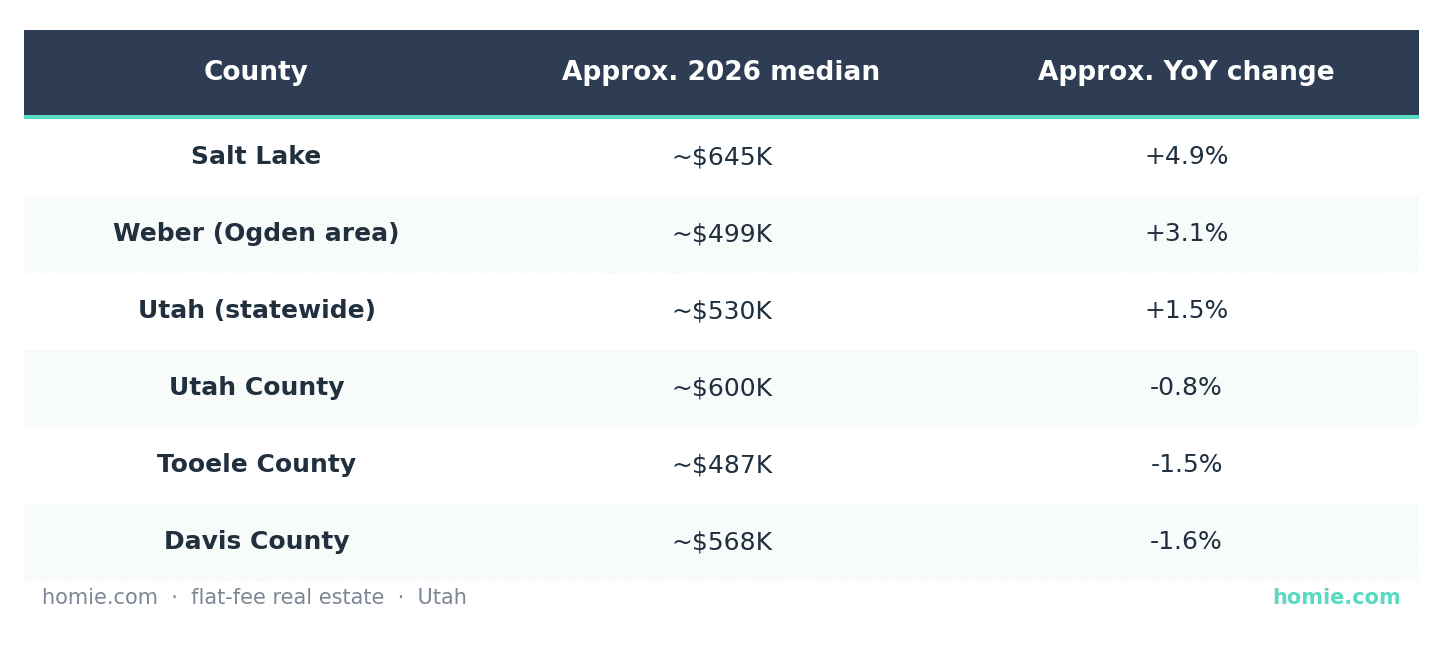 Figures are approximate, drawn from Salt Lake Board of Realtors and statewide trackers through mid-2026. Confirm current numbers before acting.
Wasatch Front cities ranked by 2026 price growth
The list below runs from fastest-rising to cooling. Every figure is approximate, and city-level year-over-year change is softer-sourced than the county data above, so read these as directional.
- Tooele (city): about +9 to 10 percent, median near $445K. The city of Tooele ran hot on first-time-buyer and commuter demand even as Tooele County overall dipped, a city-versus-county split worth noting.
- Vineyard: about +6 percent, median near $720K to $765K. Heavy new construction and the Utah Lake-adjacent master-planned buildout kept this young Utah County city rising against the county trend.
- Salt Lake City: about +3.5 percent, median near $585K. Supply-constrained close-in neighborhoods held up better than the outlying new-build markets.
- Ogden: about +3 percent, median in the low-to-mid $400Ks. The metro’s most affordable entry point drew steady first-time-buyer demand, tracking the Weber County gain.
- Murray: about +2 to 4 percent, median near $650K. A central location and limited new supply supported modest gains.
- Sandy: about +2 to 3 percent, median near $635K to $660K. Established east-bench demand kept Sandy positive but off the top.
- South Jordan: about +2 percent, median near $615K. Daybreak’s master-planned demand anchored the city.
- Draper: flat to about +2 percent, median near $760K to $925K. Silicon Slopes tech demand supported the high end, though luxury sat longer.
- West Jordan: roughly flat, median near $549K. A large, built-out valley city moved with the county average.
- Lehi: flat to slightly down, median near $700K. Silicon Slopes job demand ran into heavy new-construction supply that capped gains.
- Saratoga Springs and Eagle Mountain: flat to slightly negative, medians near $646K and $525K. The front’s biggest new-construction and commuter-growth markets saw supply outrun price gains.
- Layton, Bountiful, and Clearfield: about -1.5 percent, medians near $475K to $615K. Davis County cooled as townhome and condo supply pulled entry prices down.
Why did some Wasatch Front cities keep rising while others cooled?
Supply is the main story. Cities with heavy new-construction pipelines, Lehi, Saratoga Springs, Eagle Mountain, and much of Utah and Davis counties, added enough inventory to cap or reverse price gains, while supply-constrained Salt Lake County kept setting records. Tech-job demand around Silicon Slopes propped up the Lehi and Draper high end, and first-time-buyer demand, including Utah’s assistance program for newly built homes under a price cap, steered buyers toward the more affordable Ogden, Tooele, and Eagle Mountain markets.
- New-construction supply capped gains in Utah and Davis counties and the Utah County growth cities.
- Tech-job demand supported the Lehi and Draper high end.
- First-time-buyer demand concentrated in affordable Ogden, Tooele, and Eagle Mountain.
How does price growth relate to days on market in 2026?
They moved together: as inventory rose, appreciation slowed and homes took longer to sell. Statewide inventory climbed in 2026, with Salt Lake County new listings up and months of supply near three to four, and days on market lengthened across the front. Correctly priced homes still sold near 100 percent of list, but the leverage shifted toward buyers in the supply-heavy outlying markets. For a seller, that means pricing to current comps within your city and segment matters more than it did in the frenzied years.
What does this ranking mean for sellers timing a listing?
It means location on the front changes your strategy. In Salt Lake County and the supply-constrained close-in cities, values held or rose, so sellers there had steadier footing. In the outlying growth markets where new construction competes directly with resale, pricing discipline and presentation matter more, because a buyer can often choose a brand-new home nearby. Read your own city’s days-on-market and inventory trend, not the statewide headline, before you set a price.
Frequently Asked Questions
Which Utah city had the fastest home price growth in 2026?
Among Wasatch Front cities, the city of Tooele posted one of the largest approximate year-over-year gains, near 9 to 10 percent to a median around $445,000, on first-time-buyer and commuter demand, even as Tooele County overall dipped. Vineyard also rose strongly, near 6 percent, on new-construction demand. These are approximate city-level figures; the cleanest verified growth story is Salt Lake County’s record median, up roughly 4.9 percent.
Are Utah home prices going up or down in 2026?
It split by location. Salt Lake County rose to a record median near $645,000, up about 4.9 percent, and Weber County gained about 3.1 percent, while Utah, Davis, and Tooele counties each dipped one to two percent as new-construction supply grew. Statewide, prices were up modestly, roughly 1.5 percent. The direction depended heavily on the county and the amount of new building nearby.
Why are some Utah suburbs cooling while Salt Lake City rises?
Supply. The outlying suburbs with large new-construction pipelines, in Utah and Davis counties and cities like Lehi, Saratoga Springs, and Eagle Mountain, added enough inventory to cap or reverse price gains. Salt Lake County and close-in neighborhoods have less room to build, so constrained supply kept pushing prices up. Where builders can add homes quickly, resale appreciation tends to slow.
What is my Utah home worth?
Run a free automated valuation on Zillow, Redfin, or Homie’s home value report for a city-specific estimate, then adjust for your neighborhood and recent sold comps within a mile. Because Utah is a non-disclosure state, city medians vary by source, so a single figure is a starting point, not a price. For a high-confidence number before listing, a Utah-licensed appraiser typically runs $400 to $600.
That’s the front, ranked. If you’re timing a Utah listing and want a brokerage that will run your own city’s price growth and days-on-market trend with you before you set a number, homie.com/sell is a good place to start. We’re a licensed Utah real estate brokerage. Every figure here is an approximation from third-party data, so verify your local numbers on Redfin or with a current appraisal before you price.
— The Homie Team
- Utah News Dispatch, Salt Lake County home prices break record (SLBR Q2 2026)
- Salt Lake Board of Realtors, 2026 housing forecast report
- Redfin, Tooele housing market
- Redfin, Davis County housing market
- KSL, housing prices by ZIP code along the Wasatch Front
- Axios Salt Lake City, 2026 housing market forecast
- Community research: r/Utah and r/SaltLakeCity market and affordability threads
*All brokerage fees, including listing and buyer agent compensation, are fully negotiable and determined solely by the seller and service provider. *Flat-fee pricing and service availability may vary by location and are subject to change over time. Verify current pricing before listing. *Past performance is not indicative of future results. *Examples and potential savings are for illustrative purposes only.