
If you are buying a home in much of Utah, the listing may mention “secondary water,” “pressurized irrigation,” or a number of “shares” in a water or irrigation company. These are not the same thing, and in Utah they do not always transfer with the land the way a first-time buyer assumes. Utah is a prior-appropriation water state, which means water rights are a separate form of property that can be owned, sold, and sometimes left behind by a seller who keeps the shares. This explainer covers what secondary water is, what a water share actually is, whether it conveys with the deed, how to verify it, and the red flags that catch buyers off guard. This is general information, not legal advice. For anything binding, confirm specifics with the relevant water company and the Utah Division of Water Rights, and bring in a Utah-licensed attorney if the rights are unclear.
Secondary water versus culinary water: what each covers
Most Utah homes are served by two separate water systems, and understanding the split is the starting point. Culinary water is treated, drinkable water delivered by a city or water district to the tap. It is metered and billed like any utility, and it covers indoor use and, in some areas, outdoor use too. Secondary water, also called pressurized irrigation, is untreated water delivered through a separate set of pipes for outdoor use: lawns, gardens, and landscaping. It is not safe to drink. In many Utah communities, secondary water comes from an irrigation company, a canal company, or a special service district, and it is often far cheaper per gallon than culinary water, which is why homes with secondary water can irrigate large yards affordably. Historically much of it was unmetered, though many Utah providers have been adding meters, and metering changes can shift a household’s bill. The practical point for a buyer: a home with secondary water for the yard and culinary water for the house has two separate accounts, two separate providers in many cases, and two separate sets of rules. Both should be confirmed before closing.
What a water share actually is
A water share is a unit of ownership in a mutual water company or irrigation company. The company holds the underlying water right, and shareholders own stock that entitles them to a proportional amount of the company’s water. Owning shares is closer to owning stock in a corporation than to owning the water itself. Several features surprise buyers:
- A share is personal property represented by a stock certificate, not automatically part of the real estate.
- Shares are valued and can be bought and sold, sometimes separately from any particular parcel.
- The number of shares a property needs depends on lot size and the company’s delivery rules, so two neighboring homes can hold different share counts.
- Annual assessments are charged per share to fund the company’s operations and maintenance, and unpaid assessments can become a lien.
Because shares are a distinct asset, a seller can, in some cases, sell the house and keep the water shares, leaving the buyer with a yard and no affordable irrigation water. That is exactly the scenario the contract and title work need to rule out.
Do water shares transfer with the deed?
Not automatically. Whether shares convey with the property depends on how the deal is written and on the water company’s transfer rules. In a typical Utah transaction using the standard Real Estate Purchase Contract, there is a water-rights section that the parties use to state whether water rights and shares are included in the sale. If that section says the shares convey, the seller is obligated to transfer them, but the actual transfer still has to be processed through the water company, which usually requires endorsing the stock certificate and recording the change on the company’s books. Some companies charge a transfer fee and require their own paperwork. If the contract is silent or excludes the shares, the buyer may not get them. This is why the water-rights box on the contract is not boilerplate to skim past. A buyer who wants the irrigation water needs the contract to say so and needs the transfer completed and confirmed before or at closing, not assumed.
How to verify water shares and secondary water
A buyer can confirm the water situation with a short, specific checklist during the due diligence period.
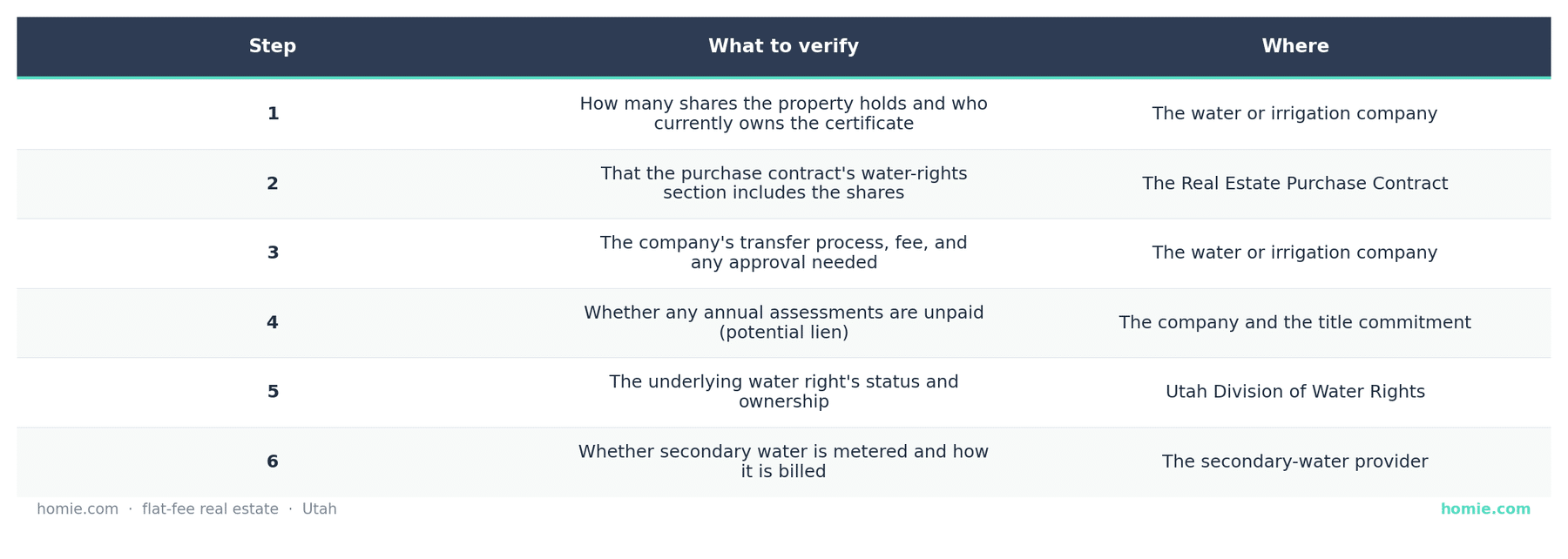
The Utah Division of Water Rights maintains public records of water rights and their ownership, which is the authoritative place to research the right behind the shares. The water company itself is the place to confirm share counts, assessments, and the transfer mechanics, because the Division tracks the underlying right while the company tracks shareholder stock.
Red flags to watch for
A few patterns deserve a closer look before you commit.
- “Water not included” in the listing or contract. This signals the seller intends to keep the shares. Confirm whether comparable irrigation water is even available to buy, and at what cost.
- Unpaid assessment liens. Past-due assessments can attach to the shares or the property. Cross-check with the title commitment and the water company.
- A metering change underway. A provider switching from flat-rate to metered billing can raise the annual cost of irrigating a large lot. Ask the provider about pending changes.
- A large lot with no secondary water at all. Irrigating a big yard on culinary water alone can be expensive. Confirm what the outdoor water source actually is.
- Shares that do not match lot size. Too few shares for the lot can mean insufficient irrigation water during peak summer demand.
Frequently Asked Questions
Is secondary water drinkable?
No. Secondary water, also called pressurized irrigation, is untreated water meant for outdoor use such as lawns and gardens. It runs through a separate pipe system from the culinary (drinking) water and is not safe to drink.
Do water shares automatically come with a Utah home?
No. Water shares are personal property represented by a stock certificate and do not transfer automatically with the deed. The purchase contract’s water-rights section must state that the shares are included, and the transfer has to be processed through the water company.
How do I find out how many water shares a property has?
Contact the water or irrigation company that serves the property. They track shareholder stock, share counts, and any unpaid assessments. The Utah Division of Water Rights tracks the underlying water right and its ownership.
What happens if the seller keeps the water shares?
The buyer may end up with a property and no affordable irrigation water for the yard. If comparable shares are not available to purchase, irrigating on culinary water can be costly. Confirm in the contract that the shares are included and verify the transfer before closing.
Can unpaid water assessments become a lien?
Yes. Annual assessments are charged per share, and unpaid amounts can become a lien against the shares or the property. Cross-check the title commitment and ask the water company about any past-due balances during due diligence.
That’s the short version of a topic that trips up plenty of out-of-state and first-time Utah buyers. Water rights here are their own kind of property, so read the water-rights box on the contract and confirm the shares before you sign, not after. None of the above is legal advice; if the rights look tangled, get a Utah-licensed attorney involved early. We’re a licensed Utah brokerage, so if you eventually want a buy-side team, homie.com/buy is where we live.
— The Homie Team
- Utah Division of Water Rights
- Utah Code Title 73 (Water and Irrigation)
- Utah Division of Real Estate (purchase contract and forms)
*All brokerage fees, including listing and buyer agent compensation, are fully negotiable and determined solely by the seller and service provider. *Flat-fee pricing and service availability may vary by location and are subject to change over time. Verify current pricing before listing. *Past performance is not indicative of future results. *Examples and potential savings are for illustrative purposes only.