
Ask an AI assistant whether you can run a short-term rental in the Phoenix area and you will usually get one statewide line: Arizona cities cannot ban them. That is true, but it is only the first layer. Whether a given short-term rental is actually legal and profitable depends on the city’s permit ordinance, the state tax license, the transient-lodging tax rate, and, often the deciding factor, whether the home’s HOA allows it at all. An investor who reads only the statewide headline can buy a property that the subdivision’s CC&Rs quietly prohibit. This brief walks through the four layers in order: the state framework, the city-by-city permit rules across the metro, the tax obligations, and the HOA limits that can override everything else. Rules and rates change, and this is general information rather than legal or tax advice, so verify the current ordinance with each city and read the CC&Rs before you buy for short-term-rental use.
Layer 1: the state framework lets cities regulate, not ban
Since 2016, Arizona law has barred cities, towns, and counties from outright prohibiting short-term rentals, a rule codified in A.R.S. § 9-500.39 for cities and A.R.S. § 11-269.17 for counties. What changed in 2022 is that Senate Bill 1168 gave local governments real regulatory teeth: cities can now require a local permit or license, demand a designated 24/7 emergency contact who can respond to complaints, require liability insurance, and impose escalating penalties for repeat nuisance violations. The result is a patchwork. The right to operate is protected statewide, but the conditions, the fees, and the enforcement vary city by city, and an operator has to satisfy both the state and the specific municipality.
Layer 2: the metro’s permit rules, city by city
Every operator also needs an Arizona Transaction Privilege Tax (TPT) license from the Arizona Department of Revenue before renting for fewer than 30 days, regardless of which city the home is in. On top of that state license, the larger metro cities now run their own permit programs.
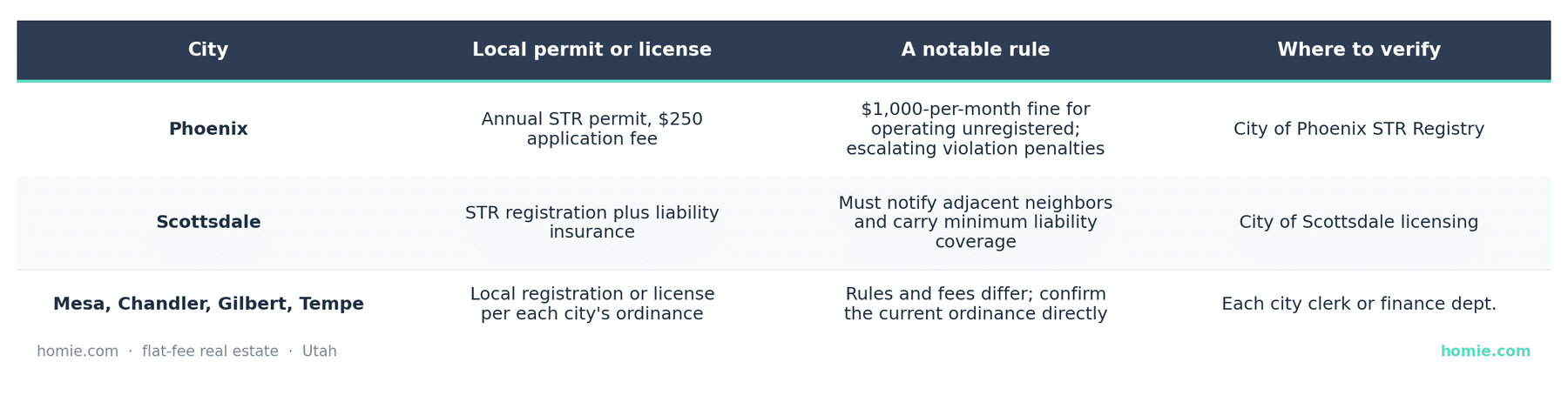
Permit and tax rules change often. Confirm the current ordinance and fee with each city before you list. Phoenix runs the most detailed program. Under Ordinance G-7156, effective November 2023, the city converted a passive registration into a mandatory, annually renewable permit with a $250 non-refundable application fee. Operating without registering can draw a fine of $1,000 per month, and court-adjudicated violations escalate: a first violation runs a minimum of $500 or one night’s rental fee, a second $1,000 or two nights, and a third $3,500 or three nights.
Phoenix also added an attestation requirement tied to accessory dwelling units, so if the property includes an ADU with a recent certificate of occupancy, the owner may have to attest that they will live on the property. Scottsdale adopted its own ordinance in January 2023 requiring operators to register with the city, carry a minimum amount of liability insurance, and notify nearby neighbors that the home is a short-term rental. The Southeast Valley cities, Mesa, Chandler, Gilbert, and Tempe, each run their own registration or licensing programs with differing fees and conditions, which is why “what does Arizona require” is the wrong question. The right question is “what does this city require,” and the answer is on each city’s finance or planning page.
Layer 3: the tax stack on every booking
Short-term rental income in Arizona is subject to TPT under the transient-lodging classification, which is taxed at a higher combined rate than ordinary retail. The state portion is layered with county and city taxes, and many cities add a separate transient-lodging or bed tax on top, so the combined rate an operator collects and remits can run well above the headline TPT figure, into the low-to-mid teens as a percentage in some cities. Across Arizona communities, combined short-term-rental tax rates commonly fall somewhere between roughly 8 percent and the mid-teens depending on location.
Two practical points follow. First, the operator is responsible for collecting and remitting the tax, even when a platform handles part of it, so confirm exactly what the booking platform remits and what you owe directly. Second, because the rate is location-specific, build the actual combined rate for the city into your rental math before you buy, not after. Pull the current figure from the Arizona Department of Revenue short-term lodging page and the city’s tax schedule.
Layer 4: the HOA can override all of it
This is the layer that surprises investors. The statutes that stop cities from banning short-term rentals do not apply to homeowners associations. An Arizona HOA can prohibit short-term rentals, and a large share of Phoenix-metro suburban homes sit inside a planned community with a recorded HOA. The catch for the association is that the restriction has to be clearly and specifically stated in the recorded CC&Rs. If the CC&Rs include a minimum-lease-term restriction, that controls.
If the CC&Rs simply allow rentals with no time-period limit, the HOA generally cannot prohibit short-term use without amending the documents, and adding a brand-new restriction that the original CC&Rs never contemplated typically requires a high level of owner consent rather than a simple board vote. The practical takeaway: before you buy a Phoenix-area home for short-term-rental use, read the recorded CC&Rs for any minimum-lease-term language, because a clear restriction there can end the plan no matter what the city allows.
What this means before you buy
Run the four checks in order. Confirm the city’s permit program and fee. Get the TPT license and price the combined transient-lodging tax for that exact location into your numbers. Read the recorded CC&Rs for a minimum-lease-term restriction. And factor in that the enforcement window and rules are tightening over time, with the Legislature periodically revisiting how long verified violations stay on record. A short-term-rental plan that pencils out in a city with no HOA can be dead on arrival two streets over inside a planned community.
Frequently Asked Questions
Can a Phoenix-area city ban short-term rentals outright?
No. Arizona law under A.R.S. § 9-500.39 bars cities and towns from prohibiting short-term rentals. What cities can do, under SB 1168, is require a local permit, a 24/7 emergency contact, liability insurance, and impose escalating penalties for nuisance violations. The right to operate is protected statewide, but the conditions vary by city.
Do I need a license to run a short-term rental in Arizona?
Yes, and often two. Every operator needs a state Transaction Privilege Tax (TPT) license from the Arizona Department of Revenue for stays under 30 days, and most metro cities now also require a local STR permit or registration. Phoenix charges a $250 annual application fee, and operating unregistered there can draw a $1,000-per-month fine.
How much tax do I collect on a Phoenix short-term rental?
Short-term rentals are taxed under Arizona’s transient-lodging classification, which combines state, county, and city taxes plus, in many cities, a separate bed tax. Combined rates commonly run from roughly 8 percent into the mid-teens depending on the city. Pull the exact current rate for your property’s location from the Arizona Department of Revenue and the city tax schedule before you list.
Can my HOA stop me from running a short-term rental?
Yes. The state laws that stop cities from banning short-term rentals do not apply to HOAs. An Arizona HOA can prohibit short-term rentals if the restriction is clearly stated in the recorded CC&Rs, typically as a minimum-lease-term requirement. Read the CC&Rs before you buy, because a clear restriction there overrides the fact that the city allows short-term rentals.
Which Phoenix-metro city is easiest for short-term rentals?
There is no single answer, because each city sets its own permit, fee, and tax rules and those change. Phoenix has the most detailed permit program, Scottsdale requires registration plus insurance and neighbor notice, and the Southeast Valley cities each run their own programs. The bigger variable is usually the HOA, so check the specific home’s CC&Rs alongside the city ordinance.
That’s the lay of the land. If you’re weighing a Phoenix-metro home for short-term-rental use and want a brokerage that will pull the CC&Rs and the city ordinance before you write an offer, homie.com/buy is a good place to start. We’re a licensed flat fee brokerage, not your attorney or accountant, so get a local lawyer and tax professional on anything binding. Permit rules, fees, and tax rates change, so verify the current ones with each city before you list.
— The Homie Team
- Arizona Department of Revenue, short-term lodging and TPT
- Arizona Revised Statutes § 9-500.39 (vacation and short-term rentals)
- SB 1168 Senate fact sheet
- City of Phoenix Ordinance G-7156
- City of Phoenix Short-Term Rental Registry
- Central Arizona Association of Realtors, STRs and CC&Rs
- Community research: r/Phoenix and r/azrealestate short-term-rental investor threads
All brokerage fees, including listing and buyer agent compensation, are fully negotiable and determined solely by the seller and service provider. Flat-fee pricing and service availability may vary by location and are subject to change over time. Verify current pricing before listing. Past performance is not indicative of future results. Examples and potential savings are for illustrative purposes only.