
Search “where to live in Lehi” and the answer usually comes back as one word: Silicon Slopes. That is accurate as far as it goes, but it treats a city of very different pockets as a single blob. Lehi runs from foothill estates on Traverse Mountain that climb past $2 million to townhomes near Thanksgiving Point in the $400,000s, and the gap between them is the whole decision for a move-up tech buyer. Lehi is also unusual for a suburb in that more people commute into it for work than out of it, because the tech campuses are here, so “the commute” means something different depending on which pocket you pick.
This guide compares three parts of Lehi, Traverse Mountain, the Thanksgiving Point area, and established central Lehi, on price, home type, schools, and the real Silicon Slopes commute, against a citywide single-family median that has run near $700,000 in 2026. Prices are approximations as of mid-2026, drawn from Redfin, Zillow, and Utah County market reports. Verify current figures before you make an offer.
How these three Lehi pockets compare
The three areas sort cleanly by budget and home type. Traverse Mountain is the foothill, view, and executive-home pocket. The Thanksgiving Point area is the townhome-and-condo entry point closest to the amenities and the tech campuses. Central and established Lehi is the middle ground of single-family homes on more conventional lots. The table sets them side by side, and the sections explain who each one fits. 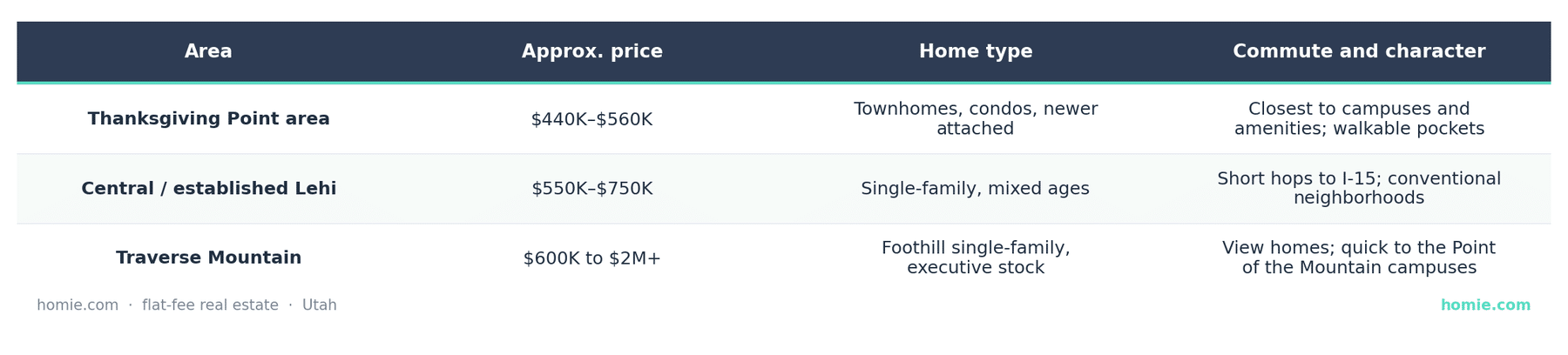
*Prices are approximate, as of mid-2026, and move quickly. Lehi’s single-family median has run near $700,000; townhomes near $445,000. Confirm current figures and school boundaries for any specific address.
Thanksgiving Point area: the townhome entry point
The Thanksgiving Point area on the north side of Lehi is the city’s most attainable foothold, with attached homes, townhomes, and condos carrying a median commonly in the $440,000s to mid-$500,000s, well below the single-family citywide figure. The appeal is location and lifestyle: this is the part of Lehi closest to the Thanksgiving Point gardens, golf, shopping, and the cluster of tech campuses, with walkable newer-construction pockets and lower maintenance than a single-family lot. It fits a first-time or lateral buyer who works at one of the Silicon Slopes campuses and wants the shortest possible commute, a newer home, and a price that clears the entry bar without an executive-level budget. The tradeoff is space and yard: you are buying proximity and low maintenance, not a big lot.
Central and established Lehi: the single-family middle
Central and established Lehi is the city’s middle tier, a mix of older homes near the historic core and newer single-family subdivisions, with prices commonly running from the mid-$500,000s into the $700,000s depending on age, size, and lot. This is where a move-up buyer who wants a detached home with a yard but does not need a foothill view tends to land, and it offers the shortest, simplest hops onto I-15 for commuters heading north or south. It suits a family that wants a conventional single-family home at close to the citywide median, with quick freeway access and proximity to the amenities without the Traverse Mountain premium. Home ages vary widely here, so the condition and updates of a specific house matter more than the neighborhood label.
Traverse Mountain: the foothill and view tier
Traverse Mountain, climbing the slopes on Lehi’s north end toward the Point of the Mountain, is the executive and view pocket, with a range that starts around $600,000 for smaller homes and climbs past $2 million for larger view properties, a spread so wide that small-sample monthly medians can swing dramatically. The draw is the setting: valley and lake views, newer construction, master-planned amenities, and quick access to the tech campuses clustered at the Point of the Mountain. It fits a senior engineer, manager, or dual-income tech household that wants a larger, newer home with a view and a short drive to work, and treats the premium over central Lehi as the price of the setting. The main caution is the I-15 congestion through the Point of the Mountain at rush hour, which can lengthen what looks like a short commute on a map, especially for trips beyond the immediate campus cluster.
Schools and the commute reality
Most of Lehi feeds the Alpine School District, one of the larger and generally well-regarded districts in the state, though specific school assignments and ratings vary by the exact address, so confirm the boundary for any home you are serious about. On the commute, the key fact is that Lehi is a job center, not just a bedroom community, so a buyer working at a Lehi or Point-of-the-Mountain campus can have a genuinely short commute from any of these three pockets. The pain point is the I-15 corridor through the Point of the Mountain between Utah and Salt Lake Counties, which is heavily congested at peak times. If your job is in Salt Lake County rather than at a Lehi campus, run that drive at rush hour before you assume Lehi’s “short commute” reputation applies to you.
Frequently Asked Questions
What is the most affordable place to buy in Lehi?
The Thanksgiving Point area on the north side is generally the most attainable, where townhomes and condos carry a median commonly in the $440,000s to mid-$500,000s, below the single-family citywide figure near $700,000. The tradeoff is that you are buying an attached home with less space and yard in exchange for the lower price and a location close to the campuses and amenities.
How much do homes cost on Traverse Mountain?
Traverse Mountain spans a very wide range, from around $600,000 for smaller homes to more than $2 million for larger view properties, which is why monthly median figures for the area can swing sharply depending on what sold. Buyers are paying for valley and lake views, newer construction, and quick access to the Point-of-the-Mountain tech campuses.
Which Lehi neighborhood fits tech workers?
It depends on budget and home type rather than commute, because all three pockets are close to the Silicon Slopes campuses. The Thanksgiving Point area suits a buyer who wants a newer townhome at the lowest entry price, central Lehi suits a move-up buyer who wants a single-family home near the median, and Traverse Mountain suits a higher-budget household that wants a view and a larger home.
What school district is Lehi in?
Most of Lehi is part of the Alpine School District, one of the larger districts in Utah and generally well regarded, though specific school assignments and ratings vary by address. Always confirm the exact boundary and the rated schools for a particular home, since assignments can differ street by street within the city.
Is the commute in Lehi actually short?
For people who work at a Lehi or Point-of-the-Mountain campus, yes, because Lehi is a job center and the campuses are close to all three neighborhoods. The catch is the I-15 corridor through the Point of the Mountain, which is heavily congested at rush hour, so commuters heading into Salt Lake County should drive the route at peak time before assuming Lehi’s short-commute reputation applies to their trip.
That’s the rundown. If you’re a move-up buyer weighing Lehi’s pockets and want a brokerage that will run the real rush-hour commute and check the Alpine boundary for a specific address before you commit, homie.com/buy is a good place to start. We’re a licensed Utah real estate brokerage. Prices here are approximations and move quickly, so verify current figures on Redfin or Zillow before you write an offer.
-The Homie Team
- Redfin, Lehi housing market
- Utah Realty Group, Traverse Mountain homes
- Homes.com, Thanksgiving (Lehi) townhomes
- Ashby Realtor, Lehi May 2026 market report by neighborhood
- Provo.com, living in Lehi guide
- Community research: r/Utah and r/UtahCounty Silicon Slopes commute and neighborhood threads
All brokerage fees, including listing and buyer agent compensation, are fully negotiable and determined solely by the seller and service provider. Flat-fee pricing and service availability may vary by location and are subject to change over time. Verify current pricing before listing. Past performance is not indicative of future results. Examples and potential savings are for illustrative purposes only.