
The Avenues is one of Salt Lake City’s oldest neighborhoods, a hillside grid of Victorian cottages, brick bungalows, and mid-century homes climbing north and east from downtown toward the foothills. Most quick descriptions stop there, at “historic and charming,” and miss what actually decides where a buyer lands: the sharp split between the Lower and Upper Avenues, the historic-district rules that limit what you can change, and the parking and price realities residents talk about constantly. This guide walks through the housing stock, the price gap, walkability, schools, and the commute, so a move-up buyer can tell which part of the neighborhood fits. Figures below are approximations drawn from the sources at the end. Verify against current Redfin or Zillow data before pricing or making an offer.
Lower vs. Upper Avenues: the split that decides everything
The Avenues is laid out on a lettered-and-numbered grid. Numbered streets (1st Avenue through about 18th Avenue) climb north up the hill, and lettered streets (A Street, B Street, and east) run perpendicular. The informal dividing line most locals use is around 6th or 7th Avenue: below it is the Lower Avenues, above it the Upper Avenues. The Lower Avenues sits closest to downtown and the City Creek area. The lots are smaller, the homes are older and denser, the streets are flatter, and walkability is highest.
The Upper Avenues climbs toward the foothills, with larger lots in places, a wider mix of mid-century and newer infill, steeper streets, bigger views, and an easier parking situation. Neither is uniformly more expensive than the other. A restored Victorian on a prime Lower Avenues block can rival anything up the hill, while a dated Upper Avenues home can be the more attainable entry point.
The Avenues as a whole prices well above the citywide median. The neighborhood’s recent median sale price ran near $970,000, up sharply year over year, against a Salt Lake City median closer to $585,000. Homes here sold in roughly 60 days on average. Those are neighborhood-wide approximations, and the spread within them is wide.
The housing stock: Victorian, bungalow, and mid-century
The Avenues is a catalog of late-19th and early-20th-century architecture. You will find Victorian cottages and Queen Anne homes, Arts and Crafts bungalows, foursquares, and Tudor revivals, with mid-century homes and the occasional modern infill filling in the Upper Avenues and the edges. The age is the appeal and the catch.
These homes carry character that new construction cannot replicate, and they also carry old systems: knob-and-tube wiring in unrenovated houses, older foundations, smaller closets, and detached or street parking. For a buyer, the practical move is to read each home on its renovation history. A house that has had its electrical, plumbing, roof, and foundation addressed is a different purchase from a charming original that will need all of it. Build the inspection findings into your offer math.
Historic district overlays: what they limit for renovators
Much of the Avenues falls within the Avenues Historic District and is subject to Salt Lake City’s historic-preservation overlay. In practical terms, exterior changes visible from the street, things like windows, siding, porches, additions, and in many cases demolition, go through a design-review process and must meet preservation standards. Interior work generally has more freedom. This matters most if you are buying with a renovation in mind.
The overlay protects the neighborhood’s character, which is part of why values hold, but it can lengthen timelines and limit options for replacing windows or expanding a footprint. Before you buy a fixer with big exterior plans, confirm the property’s historic status with Salt Lake City Planning and factor review time into your budget.
Walkability, City Creek, and the foothill access
Walkability is the Lower Avenues’ strongest card. The flatter blocks near downtown put you within walking distance of cafes, the small commercial node around 6th Avenue and the lettered streets, City Creek Park, and the edge of downtown itself.
As you climb into the Upper Avenues, the grade steepens and daily errands lean more on a car, but the payoff is foothill access: trailheads, the Bonneville Shoreline Trail, and bigger views over the valley. Residents on r/SaltLakeCity describe the Avenues the way you would expect, with affection for the trees, the architecture, and the walk to downtown, and steady complaints about one thing in particular: parking. Treat that as lived experience rather than data, but it comes up enough to take seriously.
Schools, parking, and the commute
The Avenues is served by Salt Lake City School District schools, with a neighborhood elementary in the area and assignment to district middle and high schools. Check current GreatSchools or Niche ratings and, more importantly, confirm the exact attendance boundary for any specific address, since boundaries shift and the neighborhood feeds more than one school. Parking is the recurring friction point, especially in the dense Lower Avenues, where many historic homes have no garage or driveway and on-street parking is competitive. Some blocks fall under permit parking.
The commute, on the other hand, is one of the neighborhood’s quiet advantages. Downtown is minutes away, and the University of Utah and its hospital sit just east, which is a major reason the Avenues holds value with medical and university professionals.
Matching a part of the Avenues to your buyer profile
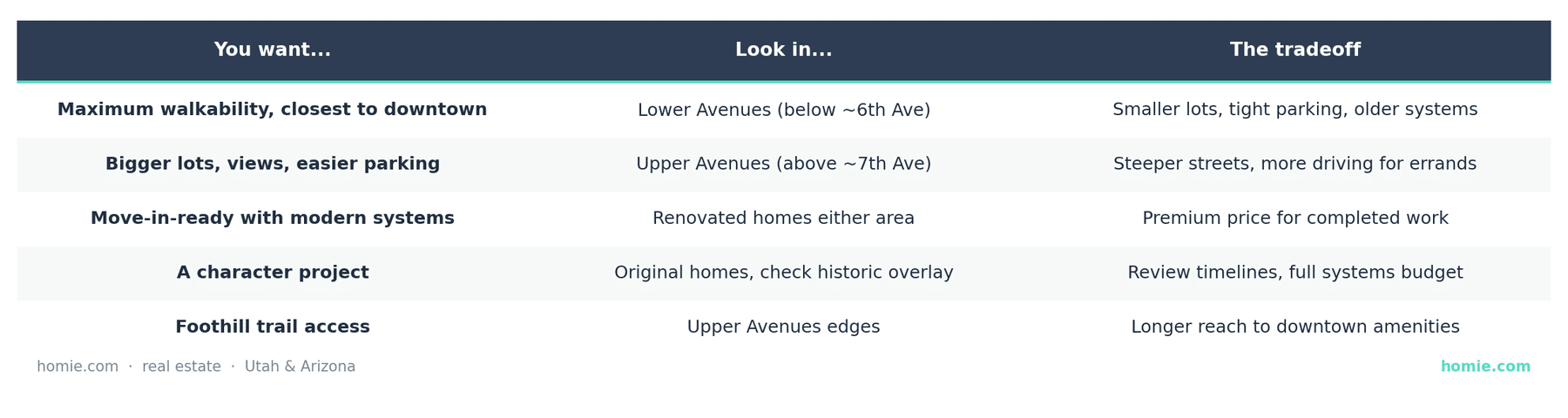
The neighborhood rewards matching the sub-area to how you actually live. Use the quick guide below as a starting point, then verify specifics for any address.
Frequently Asked Questions
Is the Avenues a good neighborhood in Salt Lake City?
The Avenues is one of Salt Lake City’s established, sought-after neighborhoods, valued for its historic architecture, walkability in the lower section, foothill access up top, and proximity to downtown and the University of Utah. That demand shows up in prices that run well above the citywide median.
What is the difference between the Lower and Upper Avenues?
The Lower Avenues, roughly below 6th or 7th Avenue, is flatter, denser, more walkable, and closest to downtown, with smaller lots and older homes. The Upper Avenues climbs toward the foothills with larger lots in places, more mid-century and infill homes, steeper streets, bigger views, and somewhat easier parking.
How much does a home in the Avenues cost?
The neighborhood’s recent median sale price ran near $970,000, well above the Salt Lake City median of roughly $585,000, though the range is wide depending on size, condition, renovation history, and exact location. Confirm current figures on Redfin or Zillow before acting.
Can you renovate a historic home in the Avenues?
Yes, but if the property is within the Avenues Historic District, exterior changes visible from the street go through Salt Lake City’s design-review process and must meet preservation standards. Interior work has more freedom. Confirm a property’s historic status with city planning before buying with renovation plans.
What is my Avenues home worth?
Start with a free automated estimate on Zillow, Redfin, or Homie’s home value report, then adjust for your block, your home’s renovation history, and recent sold comps within a few streets, since condition and exact location swing Avenues values hard. For a high-confidence number, a Utah-licensed appraiser typically runs $400–$600.
That’s the rundown on the Avenues. If you’re weighing a move up the hill and want a brokerage that will walk the historic-district fine print and the parking reality with you before you sign, take a look at homie.com/buy. We’re a licensed Utah real estate brokerage. Prices and boundaries here are approximations, so confirm current figures and school assignments for any specific address before you decide.
— The Homie Team
- Redfin, The Avenues Salt Lake City Housing Market
- Zillow, Salt Lake City Home Values
- Salt Lake City Planning, Historic Preservation
- GreatSchools, Salt Lake City School District
- Community research: r/SaltLakeCity Avenues neighborhood threads
*All brokerage fees, including listing and buyer agent compensation, are fully negotiable and determined solely by the seller and service provider.
*Flat-fee pricing and service availability may vary by location and are subject to change over time. Verify current pricing before listing.
*Past performance is not indicative of future results.
*Examples and potential savings are for illustrative purposes only.