
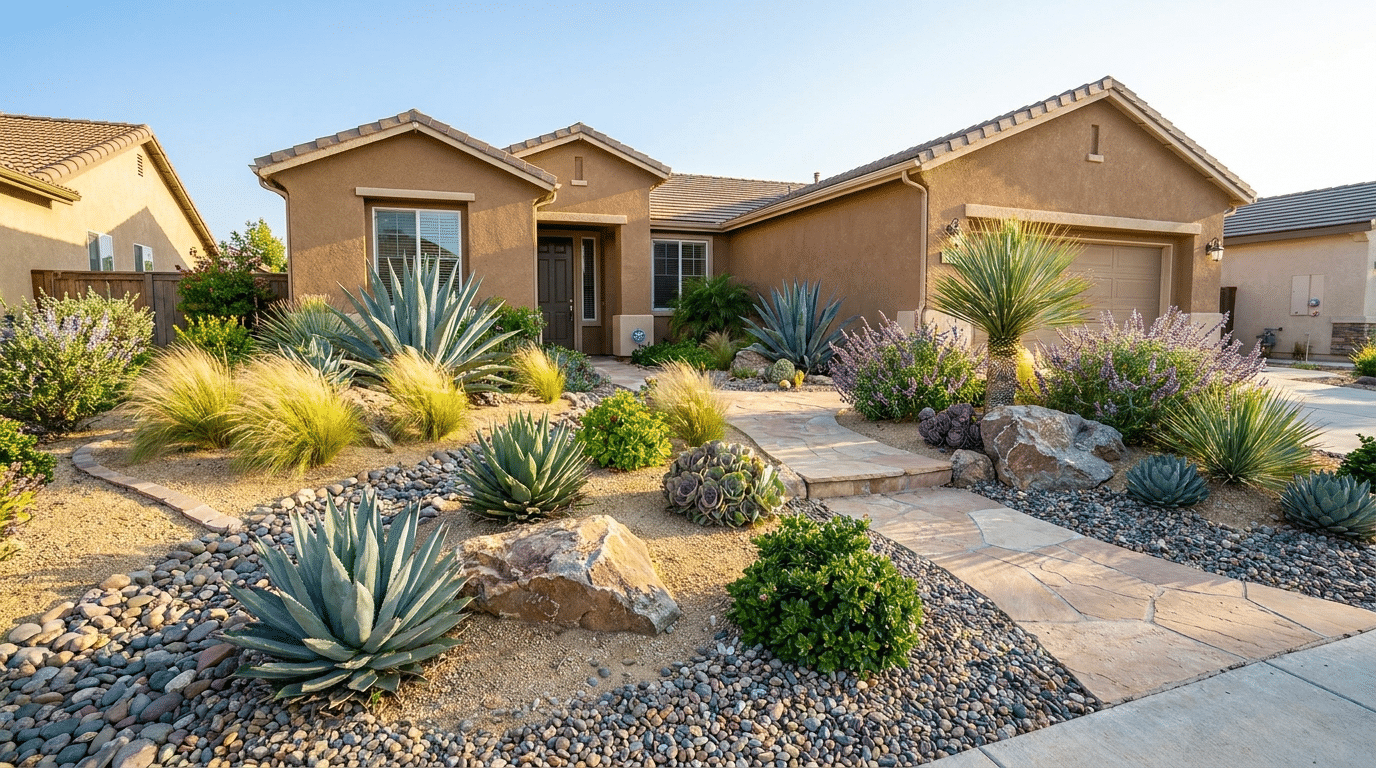
Utah is one of the driest states in the country, and after years of drought and rising water rates, more homeowners are asking a practical question: does ripping out the lawn for water-wise landscaping actually pay off, or is it just an aesthetic choice? The answer involves three separate things people tend to blur together, the water bill, the rebate, and the resale value, plus a set of HOA and city rules that can either help or get in your way. This article walks through each so you can decide whether xeriscaping makes sense for your Utah home. This is general information, not landscaping or financial advice. Rebate amounts and program rules change, so confirm current terms with your water provider before you start.
What is xeriscaping, and how is it different from “just rocks”?
Xeriscaping is landscaping designed to need little supplemental water, using drought-tolerant and native plants, efficient drip irrigation, mulch, and thoughtful design. It is not the same as a yard of bare gravel, which is often called “zeroscaping.” A done-well xeriscape, and the related “Localscapes” style developed for Utah, keeps real plant coverage, just plants suited to the climate, arranged so they are watered efficiently. The distinction matters for both water savings and resale. A thoughtful, planted water-wise yard reads as an upgrade. A field of rock with a couple of struggling shrubs reads as deferred maintenance, and buyers price it that way.
How xeriscaping cuts a Utah water bill
Outdoor watering is the big lever. In much of Utah, a large share of summer household water goes to the lawn, so reducing turf is the most direct way to cut usage. How that shows up on your bill depends on which water you are using. Many Utah homes are billed for two kinds of water. Culinary water is the treated drinking water that comes through your indoor taps and, in some homes, the outdoor spigots.
Secondary water is untreated irrigation water delivered through a separate system in many Wasatch Front communities, billed separately and historically often at a flat rate. As secondary systems add meters statewide under recent state requirements, irrigation that used to feel “free” is increasingly metered and billed by volume, which sharpens the savings from using less. Removing turf from a park strip alone can save an estimated 5,000 to 8,000 gallons of water a year.
Utah turf-removal rebates: Flip Your Strip and Localscapes
Utah has built out one of the more active turf-replacement incentive networks in the West, coordinated largely through Utah Water Savers and individual water districts. The headline programs:
- Flip Your Strip pays homeowners to replace the grass in their park strip (the area between sidewalk and street) with a water-wise design. Incentives have commonly run around $1.00 to $1.50 per square foot, with a higher rate for those who complete a free park-strip design class.
- Localscapes Rewards supports converting a full landscape to the Utah-specific Localscapes style, with reward amounts that scale by lot size, project size, and projected water savings, and typically require a minimum share of living plant coverage rather than pure rock.
- Water-district programs layer on top. Districts such as Jordan Valley Water Conservancy District have offered turf-replacement incentives in the range of roughly $1.25 to $3.00 per square foot for qualifying conversions, depending on the program and year.
The programs differ in what they cover and how they pay, so it helps to see them side by side before you choose a route.
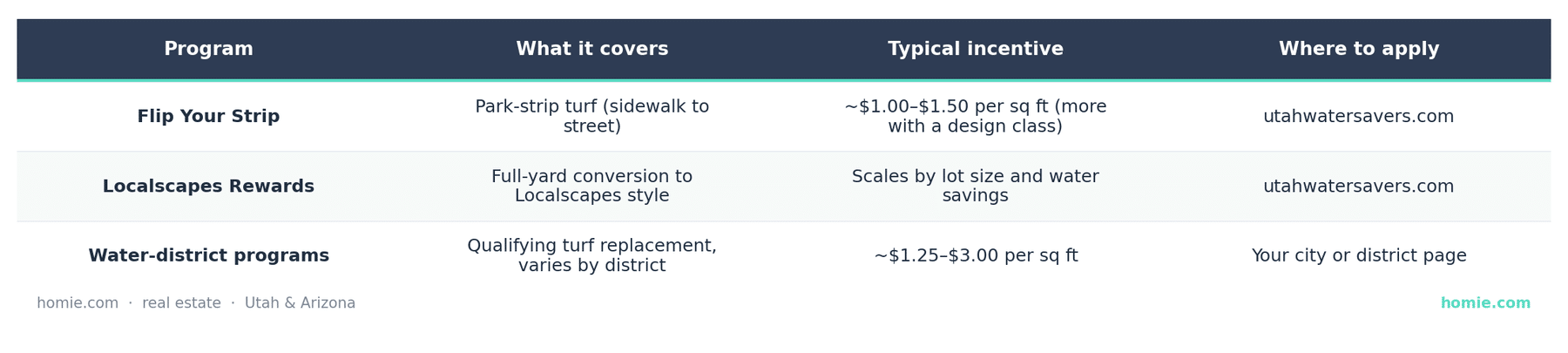
Incentive amounts are approximate, change every season, and many programs require pre-approval before you remove anything. Start at utahwatersavers.com or your city or district’s conservation page, and get approved before the first shovel goes in.
Does xeriscaping help or hurt resale value?
This is where homeowners worry, and the honest answer is “it depends on execution.” A well-designed, fully planted water-wise landscape generally helps curb appeal and signals lower ongoing costs, both of which buyers in a dry state increasingly value. Appraisers credit landscaping as part of overall site appeal and condition rather than as a line-item dollar figure, so the effect shows up in how the home shows and how quickly it sells more than in a guaranteed price bump.
The risk is a poorly executed conversion. A sparse rock yard, dead or overgrown plantings, or a design that looks out of place on the block can read as a negative and narrow your buyer pool. If resale is a near-term goal, invest in design and plant coverage, not just turf removal. The cheapest version often costs you on the back end.
What HOA and city rules can limit or require
Two layers of rules apply. First, Utah has moved to protect water-wise landscaping: state law now limits the ability of homeowners associations to prohibit drought-tolerant or water-efficient landscaping, which has cleared a path that used to be a common obstacle. That said, an HOA can still enforce reasonable design and maintenance standards, so an association may regulate how your xeriscape looks even if it cannot ban the concept. Read your CC&Rs and submit plans for approval before starting.
Second, some cities and the state have moved in the other direction on new construction and public spaces, restricting nonfunctional turf in certain settings. For an individual existing home, the practical steps are the same: check your HOA rules, check your city’s landscaping and park-strip ordinances, and confirm your rebate program’s requirements, since the rebate often dictates minimum plant coverage and approved plant lists.
Frequently Asked Questions
How much money does xeriscaping save on a Utah water bill?
It varies with how much turf you remove, your water rates, and whether you are on metered secondary water. Removing a park strip alone can save an estimated 5,000 to 8,000 gallons a year, and converting a full yard saves considerably more. As secondary water moves to volume-based metering across Utah, the dollar savings from using less are growing.
What rebates are available for removing my lawn in Utah?
The main programs are Flip Your Strip for park strips and Localscapes Rewards for full-yard conversions, coordinated through Utah Water Savers, plus water-district incentives that have ranged from roughly $1.25 to $3.00 per square foot. Amounts and rules change yearly and usually require pre-approval, so confirm current terms at utahwatersavers.com or with your provider.
Does xeriscaping increase home value in Utah?
A well-designed, planted water-wise landscape generally helps curb appeal and can speed a sale, and buyers in a dry state increasingly value lower water costs. Appraisers credit it as part of overall site appeal rather than a fixed dollar amount. A sparse, rock-only yard can hurt rather than help, so execution matters.
Can my HOA stop me from xeriscaping in Utah?
Utah law now limits an HOA’s ability to prohibit water-efficient landscaping, but associations can still enforce reasonable design and maintenance standards. Review your CC&Rs and get your plan approved before starting.
Is xeriscaping the same as putting in rocks?
No. Xeriscaping and the Utah-specific Localscapes style keep real plant coverage using drought-tolerant and native plants with efficient irrigation. A yard of bare gravel, sometimes called zeroscaping, saves less than people expect and tends to read poorly to buyers.
That’s the breakdown on water-wise landscaping in Utah. If you’re weighing a conversion partly with resale in mind and want a sense of what your home might be worth today, a free estimate at homie.com/home-value-report takes about 30 seconds. We’re a licensed Utah real estate brokerage, not landscapers or water-rights attorneys, so confirm rebate terms with your water provider and any HOA rules before you start digging.
— The Homie Team
- Conserve Water Utah, Landscape Incentive Program
- Utah Water Savers, Flip Your Strip and Localscapes Rewards
- Localscapes
- KSL, more Utah areas offering turf-removal incentives
- Community research: r/Utah homeowner landscaping threads